

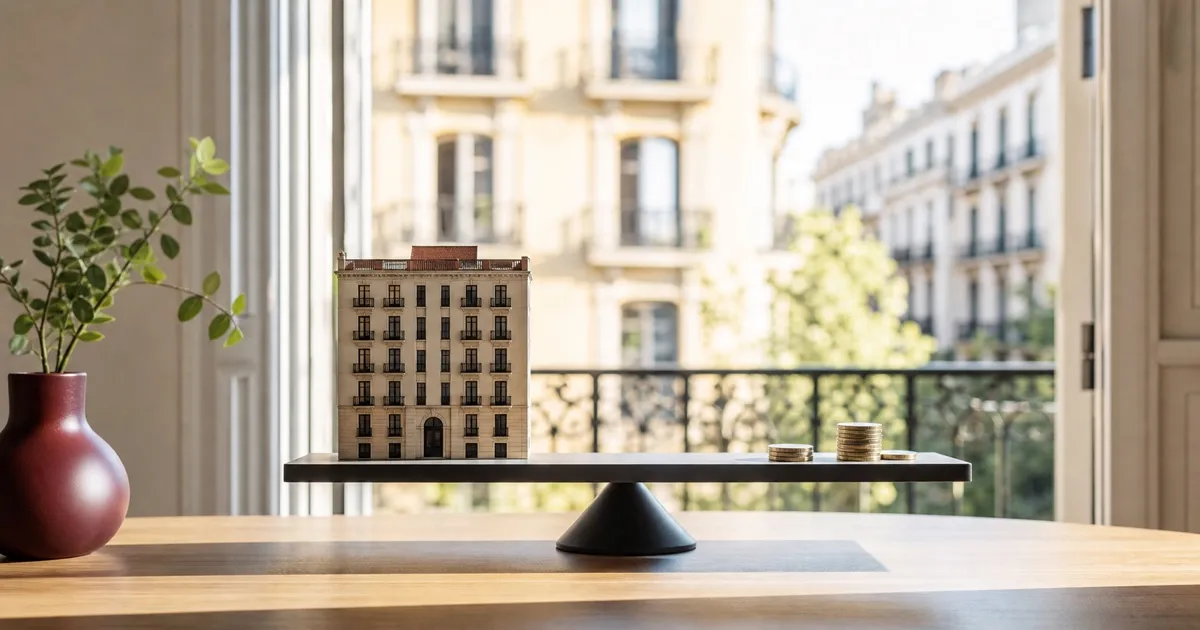
The most dangerous price in a Barcelona sale is not the low one. It is the price that is almost believable.
Too high, and buyers ignore the apartment. Too low, and you leave money on the table. But the price that is only a little too ambitious creates the worst situation: the listing receives visits, nobody commits, the first reduction comes too late, and the market starts reading the property as tired. I have seen owners lose more through slow correction than through a realistic launch price.
The numbers in 2026 make this especially tempting. INE’s Q1 2026 Housing Price Index press release (Spanish) shows national housing prices up 12.9% annually, with second-hand housing up 13.5% and prices rising 3.5% quarter-on-quarter. Tinsa places Barcelona’s Q1 2026 average finished housing price at 4,436 €/m², with +11.96% annual growth. On paper, that looks like permission to push.
But Idealista/news also reported that in Q1 2026, Barcelona and Teruel led Spain with 21% of sale listings reducing their asking price; nationally, the figure was 14%, three points higher than a year earlier. That is the part many owners skip. A rising market does not forgive every asking price.
My pricing rule: use the market’s strength to defend your price, not to invent it. A strong market helps a well-priced apartment sell with less discount. It does not turn a weak comparative into a premium property.
This guide is the method I would use before putting a Barcelona apartment on the market: start with the right evidence, separate asking prices from registered sales, adjust for the specific home, and choose a launch price that protects the final net result.
The 2026 pricing paradox: prices are rising, but reductions are rising too
Evidence frame: Generalitat de Catalunya, Registradores and INE.
If you only read the first half of the 2026 data, the conclusion is easy: Barcelona is strong, so ask high. That conclusion is incomplete.
Here is the evidence we can safely use:
| Source | What it tells us | Why it matters for pricing |
|---|---|---|
| INE IPV Q1 2026 | National housing prices +12.9% annual; second-hand +13.5%; quarterly +3.5% | Confirms the general cycle is still upward |
| Tinsa Q1 2026 | Barcelona average finished housing at 4,436 €/m²; +11.96% annual | Gives a professional valuation benchmark for the city |
| Idealista/news Q1 2026 | Barcelona and Teruel led Spain with 21% of listings reducing asking price; nationally, 14% reduced price, three points more than a year earlier | Shows that many launch prices are missing real demand |
| Registradores property statistics | Registered sales, repeated-sales price index, nationality and mortgage data | Helps separate real transactions from listing noise |
| Barcelona Dades and municipal housing data | Offer-price data and municipal housing indicators for Barcelona | Lets you compare asking behaviour with broader transaction evidence |
The contradiction is only apparent. Prices can rise and still leave many sellers overpriced. In fact, a rising market often creates more bad pricing because owners anchor to the headline, then add a personal premium: “mine has more light”, “mine is in a better street”, “I am not in a hurry”, “foreign buyers pay more”.
Sometimes those arguments are valid. Often, they are already included in the comparable properties.
The mistake is treating the average price per square metre as a blank cheque. Tinsa’s 4,436 €/m² Barcelona figure is useful, but your apartment is not “Barcelona average”. It has a district, a street, a floor, a building condition, a lift or no lift, an energy certificate, a floor plan, light, noise, community fees, and a buyer profile. The average gives orientation. It does not give the asking price.
If you want district context before going deeper, start with the Barcelona neighbourhood price guide 2026. It gives the map. This article is the next step: how to turn that map into a price for one specific apartment.
A market with +11.96% annual growth in Barcelona, according to Tinsa, can still punish a property launched above what buyers accept. The 21% Barcelona reduction signal reported by Idealista/news is the warning: the market is active, but not blind.
Do not start with portals alone
Evidence frame: Generalitat de Catalunya, Registradores and INE.
Portals are useful. They are also dangerous if you use them as the whole valuation.
The reason is simple: portal prices are asking prices. They show what owners and agencies want. They do not show what buyers finally paid at the notary. For a first scan, asking prices help you understand the competition your apartment will face on day one. But to price without losing money, you need to compare that competition with transaction evidence.
That is where Registradores and Barcelona Dades matter.
Registradores property statistics include registered sales, repeated-sales price indexes, nationality data and mortgage information. This matters because a sale price is not a marketing opinion. It is the number that survived financing, negotiation, legal review and notary signature.
Barcelona Dades and municipal housing reports add another layer because they help you compare Barcelona offer prices with broader city housing indicators. That distinction is gold for an owner. If offer prices in your area are moving faster than transaction-oriented evidence, the market may be full of ambition. If transaction evidence is catching up, the demand may be stronger than it looks.
I would read the evidence in this order:
| Step | Evidence | Question it answers |
|---|---|---|
| 1 | Current portal competition | What will buyers compare my apartment against this week? |
| 2 | Barcelona Dades offer €/m² | Is the local asking market rising, flat or inflated? |
| 3 | Transaction-oriented evidence from Registradores and municipal reports | What are buyers actually signing for nearby? |
| 4 | Registradores repeated-sales index | Is the trend supported by repeat transaction evidence? |
| 5 | Mortgage and nationality data from Registradores | Which buyer profiles can realistically pay this price? |
The order matters. If you start with portals and stop there, you price against other people’s hopes. If you start with transactions only, you may miss the live competition. A good asking price needs both.
When I value a home, I do not ask, “What is the highest comparable I can find?” I ask, “Which comparable would a serious buyer use against us in negotiation?” That one usually tells the truth faster.
Build a price corridor, not a single number
Evidence frame: Generalitat de Catalunya, Registradores and INE.
A proper valuation should not give you one magic figure. It should give you a corridor.
The corridor has three levels:
| Level | Meaning | When to use it |
|---|---|---|
| Defensive price | The price that should create strong demand quickly | If timing matters or the property has weaknesses |
| Market price | The price most supported by current evidence | If you want balance between speed and final result |
| Aspirational price | The upper edge that may work if the property has clear advantages | If the apartment is scarce and presentation is excellent |
This is where many owners lose discipline. They ask for a valuation, receive a corridor, then choose a price above the aspirational level because they want “room to negotiate”. In practice, room to negotiate often becomes room to be ignored.
A buyer does not see your internal strategy. They see a listing. If the first impression is “overpriced”, they may never book a visit. If they do visit, they use the overpricing against you. If the apartment later drops, the same buyer often returns with more confidence and a lower offer.
The right launch price should answer five questions:
- Does the price fit recent registered transaction evidence, not only asking prices?
- Can the apartment defend this price against three live competing listings?
- Are its strengths visible enough in photos, floor plan and description to justify the premium?
- Would I still believe this price after 30 days with visits but no offer?
- Does the price leave enough room for negotiation without making the launch unattractive?
The fourth question is uncomfortable. That is why I like it. It forces you to imagine the price after the initial excitement has passed.
Pricing is a bit like setting the first note in a negotiation. If the note is too sharp, everyone hears it immediately. You can adjust later, yes, but the room has already reacted.
Adjust for what buyers actually pay for
Evidence frame: Generalitat de Catalunya, Registradores and INE.
Once the evidence corridor is clear, you adjust for the apartment itself. This is where first-person fieldwork matters more than spreadsheets.
Two apartments can share the same district, square metres and asking price, while belonging to completely different buyer universes. A high-floor exterior apartment with lift and a clean floor plan attracts a different buyer from a dark interior flat in a building with pending works. A newly renovated home competes with turnkey listings. A property needing works competes with buyers who calculate risk, time, licences and construction costs.
For a Barcelona owner, I would separate the variables into price makers and price breakers.
| Variable | Usually supports price | Usually weakens price |
|---|---|---|
| Floor and light | High floor, exterior, good orientation | Low floor, interior, poor natural light |
| Building | Lift, maintained facade, clean common areas | No lift, pending works, tired entrance |
| Layout | Efficient rooms, little wasted hallway | Awkward distribution, bedrooms without comfort |
| Condition | Ready to move in, coherent finishes | Half-renovated, visible deferred maintenance |
| Energy and comfort | Better certificate, insulation, efficient systems | Poor rating, old windows, humidity or noise |
| Documentation | Clear ownership, prepared paperwork | Legal, inheritance, divorce or registry friction |
Condition deserves special care. Renovating before selling is not automatically right. Sometimes a targeted improvement creates a better sale. Sometimes a full renovation only transfers risk from the buyer to the owner without enough return. I cover that decision separately in worth renovating before selling in 2026.
The same applies to preparation. Cleaning, small repairs, neutral presentation, professional photos and documentation can defend price without pretending the apartment is something it is not. Use the complete home sale checklist before publishing, especially if the property has been lived in for many years.
According to Cristina Arias, Director of Tinsa’s Research Service, her team analyses housing data to turn market evidence into future-facing decisions. For an owner, that is the right mindset: the price should not be a feeling about the apartment, but a decision built from evidence and risk.
A premium only works when the buyer can see it. If the apartment deserves a higher price because of light, layout or condition, the listing must prove it before the visit: photos, floor plan, description and documents need to work together.
The overpricing cost: what you lose before reducing
Evidence frame: Generalitat de Catalunya, Registradores and INE.
Owners often think the cost of overpricing begins when they accept a lower offer. It begins much earlier.
You lose the first wave of demand. You lose urgency. You lose the buyers who had alerts set and were ready to visit immediately. You lose negotiation strength because the listing history starts working against you. By the time the first price reduction appears, the market has already formed an opinion.
This matters more in 2026 because Idealista/news reported that Barcelona was one of the Spanish capitals with the highest share of price reductions in Q1, at 21% of sale listings. Buyers can see the pattern. They know which homes have been sitting. They know when a seller is adjusting late.
Here is the usual sequence:
| Phase | Seller’s intention | Buyer’s reading |
|---|---|---|
| Launch above evidence | “We can always negotiate” | “They are testing the market” |
| Visits without offers | “People are interested” | “Others saw it and passed” |
| First reduction | “Now we are realistic” | “There may be more discount coming” |
| Long listing history | “We just need the right buyer” | “I can negotiate harder” |
The painful part is that the final accepted price can end up lower than the price the owner would have achieved with a sharper launch. Not because the apartment changed. Because the buyer’s perception changed.
I do not like panic pricing. I do not like giving away money. But I dislike stale listings even more because they create a discount without creating speed.
If the only reason for your asking price is “we can come down later”, the launch price is probably not ready. Negotiation room should be designed, not improvised.
A practical pricing method before you list
Evidence frame: Generalitat de Catalunya, Registradores and INE.
This is the pricing sequence I would follow before publishing an apartment in Barcelona.
1. Define the true comparable set
Do not compare only by district. Compare by micro-area, building type, lift, floor, light, condition and usable layout. Three close comparables are better than twenty vague ones.
2. Separate asking evidence from transaction evidence
Use portal listings to understand competition. Use Registradores and Barcelona Dades to anchor reality. The gap between offer €/m² and registered transaction €/m² is often where the pricing risk lives.
3. Mark the apartment’s defendable premiums
A premium needs proof. “Bright” should be visible. “Renovated” should be coherent. “Good location” should connect to transport, services and buyer demand, not just personal affection for the street.
4. Identify the buyer profile
A family buyer, an investor, an international buyer and a downsizer do not all value the same things. Registradores’ nationality and mortgage data can help you understand how much of local demand depends on financing or foreign buyer presence.
5. Choose the launch strategy before emotion enters
Decide in advance what you will do after 14, 30 and 45 days. If visits are strong but offers are absent, the issue may be price. If visits are weak, the issue may be price, presentation or distribution.
- I have reviewed current competing listings in the same micro-area
- I have checked transaction-oriented evidence, not only asking prices
- I know the apartment's three strongest price arguments
- I know the two objections buyers will probably raise
- I have a review date for the pricing strategy before publishing
If the apartment is tied to inheritance, divorce or a legal valuation need, be even more careful. In those cases the price is not only a marketing decision; it may affect family negotiation, tax expectations or court-facing documentation. For that scenario, read the guide on real estate valuation for inheritances and divorces in Barcelona.
My recommendation for Barcelona owners in 2026
Evidence frame: Generalitat de Catalunya, Registradores and INE.
In the current market, I would not underprice a good Barcelona apartment. The evidence does not support fear. INE shows strong national growth, Tinsa shows Barcelona rising sharply, and buyer demand remains active enough to sustain serious prices.
But I would be very disciplined with the launch price.
The winning strategy in 2026 is not “price low”. It is “price with evidence, then present the apartment so well that the evidence is obvious”. That means using INE and Tinsa for context, Idealista/news as a warning about reductions, Registradores for transaction reality, and Barcelona Dades to compare offer behaviour with municipal housing indicators.
If you are still deciding whether this is the right moment to sell, start with the signs it may be the right time to sell your home in Barcelona. If the decision is already made, move from timing to execution: pricing, preparation, documentation and negotiation.
Set a price that a serious buyer can understand in the first five minutes and that you can defend with evidence in the first negotiation. That is how you protect the final result.
Before listing, I would do three things this week:
- Pull the closest active comparables and remove anything that is not truly comparable.
- Check transaction-oriented evidence through Registradores and municipal housing data before trusting portal averages.
- Ask for a valuation that explains the corridor, the likely buyer profile and the reduction plan if demand does not appear.
If you want that work done with the property in front of us, not as a generic estimate, the next step is selling with Pedro. A good price is not a number pulled from a portal. It is a strategy designed before the first buyer calls.
Sources consulted
Evidence frame: Generalitat de Catalunya, Registradores and INE.
Sources
- Compravendes habitatges registrades Barcelona
- Estadisticas de propiedad
- Indice de Precios de Vivienda
- Precio de la vivienda en Espana
- Espana Observatorio inmobiliario mayo 2025
- INE Housing Price Index Q1 2026 press release
- Tinsa Barcelona city housing prices
- Idealista price reductions in listings Q1 2026
- Cristina Arias expert profile
- Barcelona Dades portal