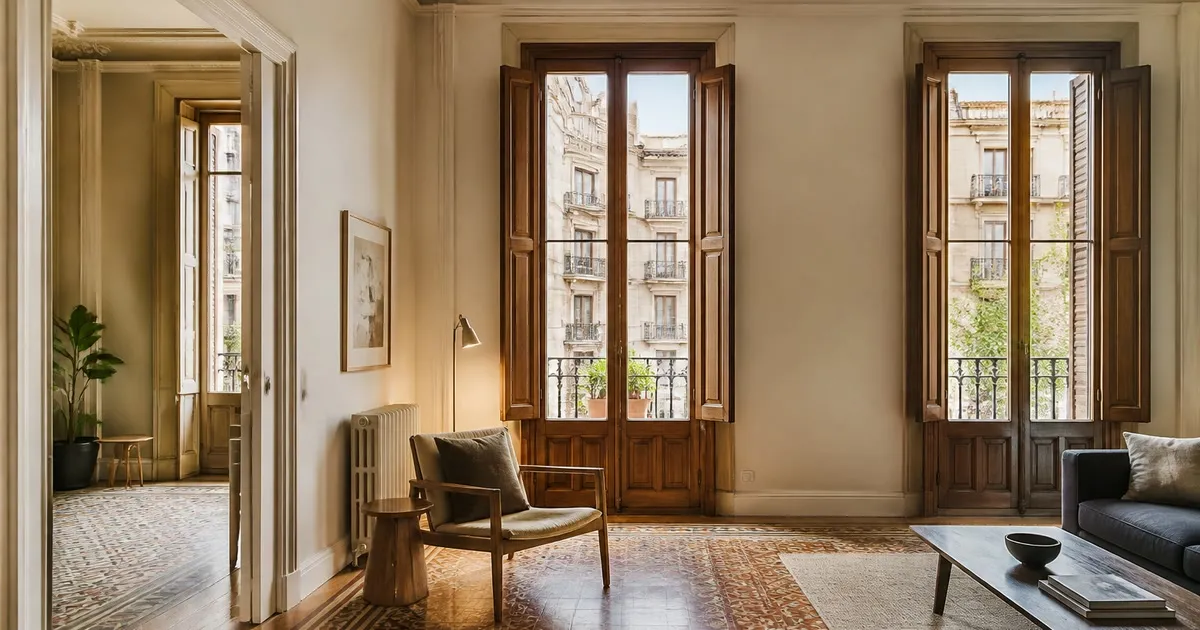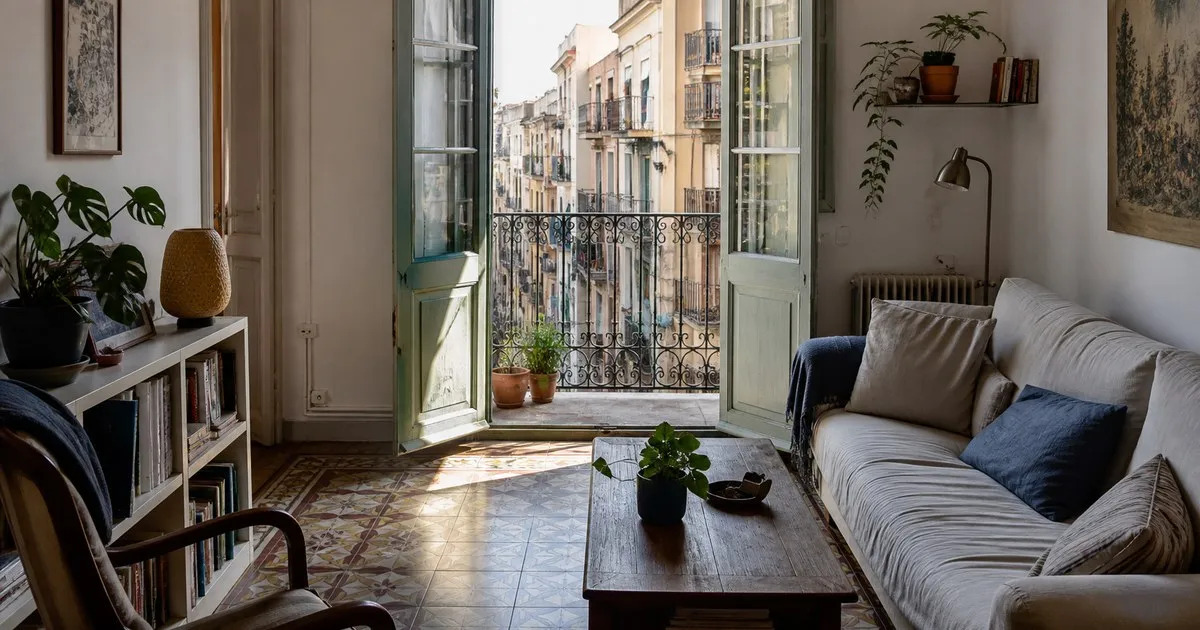



There is a widespread belief among property owners: “If I renovate before selling, I’ll get much more money.” Sometimes that is true. Other times the work absorbs margin, delays the listing, and does not come back in the final price. The difference between making or losing money is not about renovating - it is about knowing when and how to do it.
In a market like Barcelona’s in 2026, where prices are rising, demand outstrips supply, and public subsidies are running out, the renovation decision needs evidence rather than instinct. This article gives you a practical framework to test that decision before spending money.
Barcelona’s 2026 market: context for your decision
Evidence frame: Generalitat de Catalunya, Spanish Tax Agency and IDAE.
Before deciding whether to renovate, you need to understand the landscape. And in Barcelona in 2026, the landscape is a rising market with constrained supply.
The numbers that matter
Prices at historic highs: The average property price in Barcelona city stands at approximately 4,269 euros per square meter according to Tinsa (Q4 2025), with growth forecasts of 3-6% for 2026. In districts like Sarria-Sant Gervasi or Eixample, prices exceed 5,000-6,000 euros per square meter.
Surging demand: Between January and September 2025, 55,465 properties were sold in Barcelona province - a 19% increase year-over-year (INE 2025). Foreign demand continues to grow, attracted by the climate, quality of life, and prices that remain competitive compared to other European capitals.
Limited supply: Barcelona has little room for new construction in consolidated areas. This creates pressure on existing housing stock and can help move-in-ready properties compete better than homes with pending works, provided the premium is supported by comparable evidence.
More discerning buyers: The average buyer profile seeks “turnkey” homes. They prioritize energy efficiency, quality materials, and functional layouts. A 1990s kitchen or a dated bathroom can eliminate your property from the shortlist before the first viewing.
2026 market snapshot: use Tinsa for price context, official transaction data for activity and municipal sources to understand supply. But here is the nuance: in a supply-constrained market, even unrenovated apartments sell. The real question is not whether you will sell, but at what price and how quickly.
The nuance most people miss
In a scarcity market like the current one, your apartment will probably sell even without renovation. The question is how much money you leave on the table. If the difference between selling renovated and unrenovated is 30,000 euros but the renovation costs 45,000 euros, you are losing 15,000 euros. If the difference is 60,000 euros and the renovation costs 30,000 euros, you are gaining 30,000 euros.
The key is running the numbers, not making assumptions. And for that, you need a framework.
The golden rule: when renovating does pay off
Evidence frame: Generalitat de Catalunya, Spanish Tax Agency and IDAE.
There is no universal answer. But there is a method for deciding. I have developed a 4-condition framework that I use with my clients. All four must be met for the renovation to be advisable:
Condition 1: The price gap justifies the investment
The difference between the renovated value and the current value must exceed the renovation cost plus a 20-30% margin. This margin covers unexpected costs (there are always some), the opportunity cost of time, and the stress of the process.
Formula: (Renovated value - Current value) must exceed (Renovation cost x 1.3)
Condition 2: Your neighborhood has sufficient price ceiling
There is no point investing 50,000 euros in a renovation if your neighborhood has a price ceiling that limits appreciation. An apartment in Nou Barris has a very different market ceiling than one in Eixample.
Condition 3: Execution is feasible in under 3 months
Every month your apartment is under construction is a month it is off the market. In a rising market, losing 3-6 months can cost more than what you gain from the renovation. The market window matters.
Condition 4: There are no structural or legal issues to resolve first
If your building has foundation problems, an unfavorable building inspection (ITE), or pending litigation, cosmetic renovation will not solve the real problem. Structural issues must be addressed first.
The quick 10-15% rule: If you can increase your property’s value by 10-15% while spending only 3-5% of its current value, the renovation almost always pays off. Example: a 300,000-euro apartment where you invest 12,000 euros (4%) and raise the price to 340,000 euros (+13%). Net gain: 28,000 euros.
Practical example: 80 m2 apartment in Gracia
| Item | Unrenovated | Renovated |
|---|---|---|
| Market value | 320,000 euros | 385,000 euros |
| Renovation cost | - | 35,000 euros |
| Gross return | 320,000 euros | 385,000 euros |
| Net return (after renovation) | 320,000 euros | 350,000 euros |
| Gain from renovating | - | +30,000 euros |
| Estimated time to sell | 4-6 months | 1-3 months |
In this case, renovating generates 30,000 euros of net profit and accelerates the sale by 2-3 months. The renovation clearly pays off.
But change the numbers: if the apartment is worth 320,000 euros unrenovated and the neighborhood ceiling limits the renovated value to 345,000 euros, with a renovation cost of 35,000 euros, you would be losing 10,000 euros. That is why running the numbers before deciding is critical.
When not to renovate (and what to do instead)
Evidence frame: Generalitat de Catalunya, Spanish Tax Agency and IDAE.
There are scenarios where renovating before selling is a mistake. Recognizing them in time can save you tens of thousands of euros.
Scenario 1: Your neighborhood has a low price ceiling
If you live in an area where the maximum price per square meter is limited, the renovation will not translate into a proportional increase in sale price. Example: investing 40,000 euros to renovate an apartment in a zone with an average price of 2,500 euros per square meter when the renovated ceiling is 3,000 euros per square meter. For a 70 m2 apartment, that means a theoretical maximum increase of 35,000 euros - less than the investment.
Alternative: Home staging and cosmetic improvements (paint, deep cleaning, decluttering) for 2,000-4,000 euros.
Scenario 2: The market is rising rapidly
When prices are climbing quickly, every month you spend renovating is money lost. If Barcelona rises 5% annually and your renovation takes 4 months, a 400,000-euro apartment will have appreciated by about 6,700 euros in that period. Selling quickly may be better than selling renovated.
Alternative: Immediate sale at an adjusted price, with margin for the buyer to renovate to their own taste.
Scenario 3: The property has structural problems
Cracks in load-bearing walls, rising damp, or obsolete gas/electrical installations requiring technical projects. These problems demand technical solutions before any cosmetic renovation.
Alternative: Obtain structural repair quotes, include them in the sales documentation, and adjust the price. Transparency builds trust.
Scenario 4: You do not have a budget with a contingency buffer
Renovations always cost more than planned. The industry rule is to add 15-20% to the initial budget for contingencies. If your budget is tight, a surprise (hidden plumbing, asbestos, faulty wiring) can leave you halfway through.
Alternative: Invest only in improvements you can fully control: paint, cleaning, home staging.
Scenario 5: Your personal taste is very distinctive
Renovating with artisanal Moroccan tiles, bold colors, or an industrial kitchen may delight you, but it can alienate 80% of potential buyers. Over-personalization is the most expensive mistake in pre-sale renovations.
Alternative: If you do renovate, choose neutral, universal finishes. White, light gray, natural wood. What appeals to everyone.
Food for thought: A pre-sale renovation fails when it starts without market analysis, neighborhood comparables and a fixed budget with contingency margin.
Home staging: the alternative few people know about
Evidence frame: Generalitat de Catalunya, Spanish Tax Agency and IDAE.
If renovating does not make sense in your case, home staging may be the solution. And if renovating does make sense, home staging is the perfect complement to maximize your return.
What it is (and what it is not)
Home staging is the professional preparation of a property for sale. It is not interior decorating or personal design. It is a real estate marketing technique that aims to help the largest number of potential buyers visualize themselves living in your apartment.
It includes: depersonalization, furniture rearrangement, strategic lighting, neutral decorative elements, and sometimes temporary rental furniture.
It does not include: construction work, renovations, installations, or structural changes.
The numbers behind home staging
The data is compelling:
- Time to sell: Staged homes sell 73% faster in Barcelona (Home Staging Spain 2024)
- Sale price: Between 5% and 15% higher compared to equivalent unstaged properties
- ROI: Between 280% and 400% on the staging investment
- Average cost: 1,500-5,000 euros (empty property with rental furniture: 3,000-5,000 euros; furnished property with adjustments: 1,000-2,500 euros)
Comparison: home staging vs partial renovation vs full renovation
| Criteria | Home Staging | Partial Renovation | Full Renovation |
|---|---|---|---|
| Investment | 1,000-5,000 euros | 8,000-20,000 euros | 40,000-80,000 euros |
| Execution time | 1-5 days | 2-6 weeks | 2-6 months |
| Average ROI | 280-400% | 80-150% | 60-120% |
| Risk | Very low | Medium | High |
| Ideal for | Apartments in good condition or with low price ceiling | Apartments with very outdated elements | Very deteriorated apartments in premium neighborhoods |
| Sale price increase | 5-15% | 10-20% | 20-40% |
Real case: 75 m2 apartment in Sant Marti, energy certificate E, unrenovated since 2005. Home staging investment: 2,800 euros (depersonalization, partial painting, rental furniture, professional photography). Result: sold in 23 days for 265,000 euros, compared to an initial estimate of 245,000 euros without staging. Net benefit from staging: 17,200 euros. ROI: 614%.
When to choose each option
- Home staging only: Apartment in generally good condition, neighborhood with moderate price ceiling, need to sell quickly
- Home staging + partial renovation: Very outdated kitchen or bathroom but correct structure and layout
- Full renovation + home staging: Very deteriorated apartment in a premium neighborhood (Eixample, Sarria-Sant Gervasi) where the price gap justifies the total investment
The energy factor: the silent revolution of 2026
Evidence frame: Generalitat de Catalunya, Spanish Tax Agency and IDAE.
If there is one factor changing the rules of the game in property sales, it is energy efficiency. And in 2026, this goes from being a commercial argument to a regulatory obligation.
The EU directive that changes everything
The Energy Performance of Buildings Directive (EPBD) establishes mandatory milestones:
- 2030: All residential properties must have a minimum energy certificate of E
- 2033: The minimum rises to certificate D
- 2050: All buildings must be zero-emission
This is not a recommendation. It is binding regulation that member states must transpose into national law.
The current state of Spain’s housing stock
82% of homes in Spain have energy certificates of E, F, or G (IDAE 2024). This means the vast majority of apartments being sold today will need mandatory energy upgrades before 2030-2033. Buyers know this, and they are factoring it into the price.
The “green premium” is already real
The available evidence points in a clear direction: the energy certificate is no longer just paperwork. IDAE and the Spanish Tax Agency treat it as a central piece of renovation policy, and buyers increasingly compare inefficient homes against more comfortable alternatives.
| Current certificate | Upgrade to | Estimated cost | Value added (300,000-euro apt) | Net benefit |
|---|---|---|---|---|
| G | F | 1,500-3,000 euros | +3,900 euros (+1.3%) | +900 to +2,400 euros |
| F | E | 3,000-6,000 euros | +3,900 euros (+1.3%) | Neutral to -2,100 euros |
| E | D | 5,000-10,000 euros | +3,900 euros (+1.3%) | -1,100 to -6,100 euros |
| G | D | 8,000-15,000 euros | +11,700 euros (+3.9%) | -3,300 to +3,700 euros |
| G | B | 15,000-30,000 euros | +19,500 euros (+6.5%) | -10,500 to +4,500 euros |
| F | A/B | 20,000-40,000 euros | +29,100 euros (+9.7%) | -10,900 to +9,100 euros |
Mind the deadlines: If your property has F or G certification, waiting can make it less attractive than comparable efficient homes. Improving now, with subsidies, is usually easier to control than rushing later under stronger regulatory or buyer pressure.
Concrete measures to improve certification
- Double-glazed windows with thermal break: 3,000-6,000 euros (80 m2 apartment). Improvement of 1-2 letters.
- Facade insulation (if community renovation): 4,000-8,000 euros per dwelling. Improvement of 2-3 letters.
- Aerothermal heat pump (replacing gas boiler): 4,000-8,000 euros. Improvement of 1-2 letters.
- Solar panels (for single-family or community): 3,000-6,000 euros. Improvement of 1 letter.
Subsidies and tax deductions expiring in 2026
Evidence frame: Generalitat de Catalunya, Spanish Tax Agency and IDAE.
This is the factor that needs the clearest date check in 2026. Grants and tax deductions have different windows, and eligibility should be verified before budgeting the work.
Recovery plan (PRTR) - next generation EU
European funds allocated to energy rehabilitation cover between 40% and 80% of the cost of work, depending on the level of improvement achieved:
- 30% improvement in energy consumption: 40% subsidy
- 45% improvement or more: 60% subsidy
- 60% improvement or more: 80% subsidy
Deadline for completion of works: June 30, 2026. Works must be finished and documented before that date.
Income tax (IRPF) deductions
Tax deductions for energy improvements offer additional benefits:
- 20% deduction for works reducing heating/cooling demand by 7% (maximum base 5,000 euros)
- 40% deduction for works reducing non-renewable primary energy consumption by 30% (maximum base 7,500 euros)
- 60% deduction for energy rehabilitation works in residential buildings (maximum base 5,000 euros per year, cumulative up to 15,000 euros)
Deadline: Works must be completed before December 31, 2026.
Regional and local subsidies (Catalonia/Barcelona)
There are also regional and local programs:
- Catalonia Housing Agency: Rehabilitation subsidies of up to 6,000-21,400 euros per dwelling
- Barcelona City Council: Rehabilitation aid programs in specific neighborhoods
- Reduced property tax (IBI): Reductions for high energy efficiency properties
Optimal subsidy combination example: Energy renovation costing 15,000 euros (windows + aerothermal pump). With a 40% PRTR subsidy (-6,000 euros) and 40% income tax deduction on the remainder (-3,600 euros), the effective cost is just 5,400 euros. For an improvement that can add 10,000-15,000 euros to your property’s value. These opportunity windows have expiration dates: As of June 29, 2026, the PRTR window is at its scheduled June endpoint and income tax deductions still use December 2026 as the time reference.
Subsidy summary table
| Subsidy | Amount | Deadline | Main requirement |
|---|---|---|---|
| PRTR Next Generation | 40-80% of cost | Works completed Jun 2026 | Energy certificate improvement |
| Income tax - 20% deduction | Up to 1,000 euros | Dec 31, 2026 | 7% reduction in heating demand |
| Income tax - 40% deduction | Up to 3,000 euros | Dec 31, 2026 | 30% reduction in energy consumption |
| Income tax - 60% deduction | Up to 5,000 euros/year | Dec 31, 2026 | Full building rehabilitation |
| Catalonia | 6,000-21,400 euros | Per call | Comprehensive rehabilitation |
The 3-budget method: your decision framework
Evidence frame: Generalitat de Catalunya, Spanish Tax Agency and IDAE.
Now that you have the full context, here is the method I use with my clients to make the decision objectively. I call it the 3-Budget Method.
Step 1: Professional valuation (unrenovated)
Request a professional valuation of your property in its current state. Do not do it yourself using property portals: listing prices are not sale prices. You need real comparable data from closed transactions in your neighborhood over the last 6 months.
Step 2: Renovated potential valuation
With professional help, estimate what your property would be worth renovated, based on comparable renovated properties of similar characteristics in your same neighborhood. The area’s price ceiling is your absolute limit.
Step 3: Fixed renovation budget
Obtain at least 2-3 detailed quotes from renovation companies with verifiable references. Add a 30% margin to the average (15% for contingencies + 15% safety buffer).
The decision formula
If (Renovated value - Current value) exceeds (Renovation cost x 1.3), then renovating pays off.
The 1.3 factor includes the safety margin. If the result is positive, the renovation makes economic sense. If it is negative or very tight, it is better not to renovate.
Three typical scenarios
| Scenario | Current value | Renovated value | Renovation cost | Cost x 1.3 | Gap | Decision |
|---|---|---|---|---|---|---|
| A: Profitable | 280,000 euros | 355,000 euros | 35,000 euros | 45,500 euros | +29,500 euros | Renovate |
| B: Marginal | 310,000 euros | 350,000 euros | 28,000 euros | 36,400 euros | +3,600 euros | Do not renovate (insufficient margin) |
| C: Not profitable | 250,000 euros | 275,000 euros | 30,000 euros | 39,000 euros | -14,000 euros | Definitely do not renovate |
Scenario B is the most dangerous because it seems like it “almost” pays off. But a 3,600-euro margin disappears with the first unexpected issue. In these cases, home staging is the smart choice.
The 5 interventions with the best cost-to-impact ratio
Evidence frame: Generalitat de Catalunya, Spanish Tax Agency and IDAE.
If you decide to renovate, or even if you decide against a full renovation, these are the 5 interventions that generate the highest return per euro invested. They are the “quick wins” that work in almost any scenario.
1. Paint + deep cleaning
Investment: 800-1,500 euros (80 m2 apartment) Estimated ROI: 150-200% Time: 3-5 days
This is the intervention with the best cost-to-result ratio. Neutral colors (off-white, pearl gray, warm beige), matte or satin finishes. A freshly painted home conveys cleanliness, care, and spaciousness. Combined with a professional deep clean (200-400 euros), it completely transforms the first impression.
2. Energy certificate improvement
Investment: 3,000-8,000 euros (depending on measures) Actual cost with subsidies: 1,000-3,000 euros Estimated ROI: 100-300% (considering subsidies)
The best time to do this is now, while subsidies cover 40-80% of the cost. Double-glazed windows and aerothermal heat pumps are the two measures with the best impact per euro invested. For more detail on each type of energy renovation, see our complete guide to renovations that increase your home’s value.
3. Bathroom: swap bathtub for walk-in shower + modern fixtures
Investment: 2,000-3,500 euros Estimated ROI: 80-120% Time: 3-5 days
You do not need to renovate the entire bathroom. Replacing the bathtub with a flush-mounted shower tray and glass screen, updating the fixtures, and adding a modern vanity unit can transform a 1990s bathroom for a fraction of the cost of a complete renovation.
4. Kitchen: replace cabinet fronts and countertop without changing layout
Investment: 3,000-6,000 euros Estimated ROI: 80-120% Time: 1-2 weeks
Replacing cabinet fronts, installing a Silestone or similar countertop, and updating handles can rejuvenate a kitchen by 20 years without changing the layout or plumbing. Adding a new induction cooktop is a bonus that buyers particularly value.
5. Professional home staging
Investment: 1,500-4,000 euros Estimated ROI: 280-400% Time: 1-5 days
As we have seen, home staging offers the highest ROI of all interventions. It is especially effective when combined with one of the above: a freshly painted apartment with professional home staging creates an impression comparable to a fully renovated property, at a fraction of the cost.
For a closer look at kitchen, bathroom, flooring, smart-home and energy-efficiency work, use the article on renovations that increase your home’s value the most in 2026.
The 3 questions you must ask yourself
Evidence frame: Generalitat de Catalunya, Spanish Tax Agency and IDAE.
Renovating before selling can be an excellent decision, but only when the right conditions are met. The difference between gaining 30,000 euros and losing 15,000 euros lies in running the numbers before calling the contractor.
Before deciding, ask yourself these three questions:
-
What is the real gap between my unrenovated and renovated apartment in my neighborhood? If you cannot answer with real comparable data, you are not ready to decide.
-
Can I complete the renovation in under 3 months, with a fixed budget and contingency margin? If the answer is no, the risk outweighs the potential benefit.
-
Have I explored the alternatives? Home staging, cosmetic improvements, and energy efficiency with subsidies can offer better returns with much less risk.
As of June 29, 2026, the PRTR window is already at its scheduled June endpoint, while income tax deductions still use December 2026 as the reference. Treat this as an eligibility and documentation check, not as a generic urgency claim.
Need clarity on your specific situation? At Pedro Ochoa Inmobiliaria, we offer a free property valuation that includes a personalized analysis of renovation potential vs. direct sale. We help you decide with data, not assumptions. Get in touch and we will advise you with no obligation.
Sources