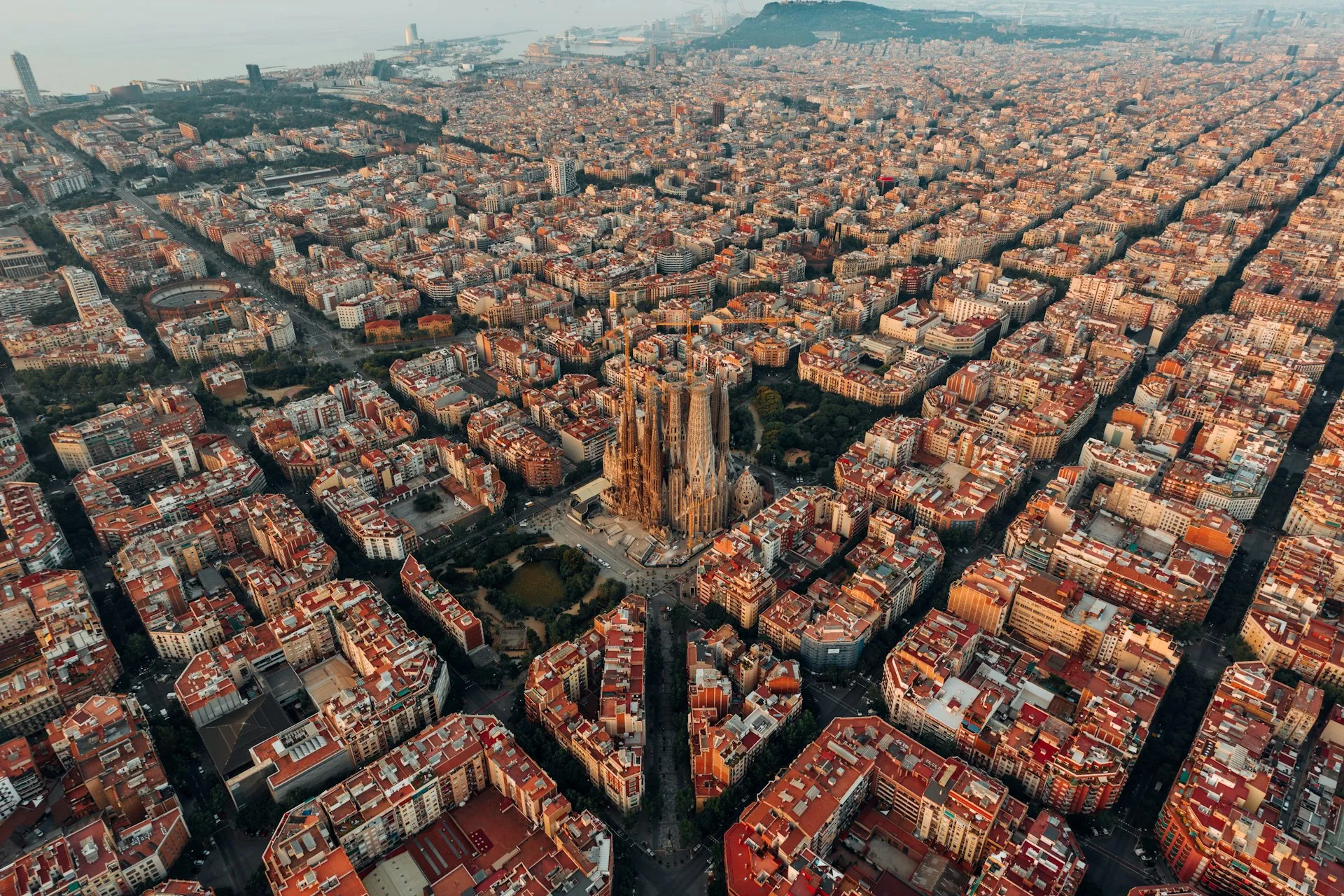


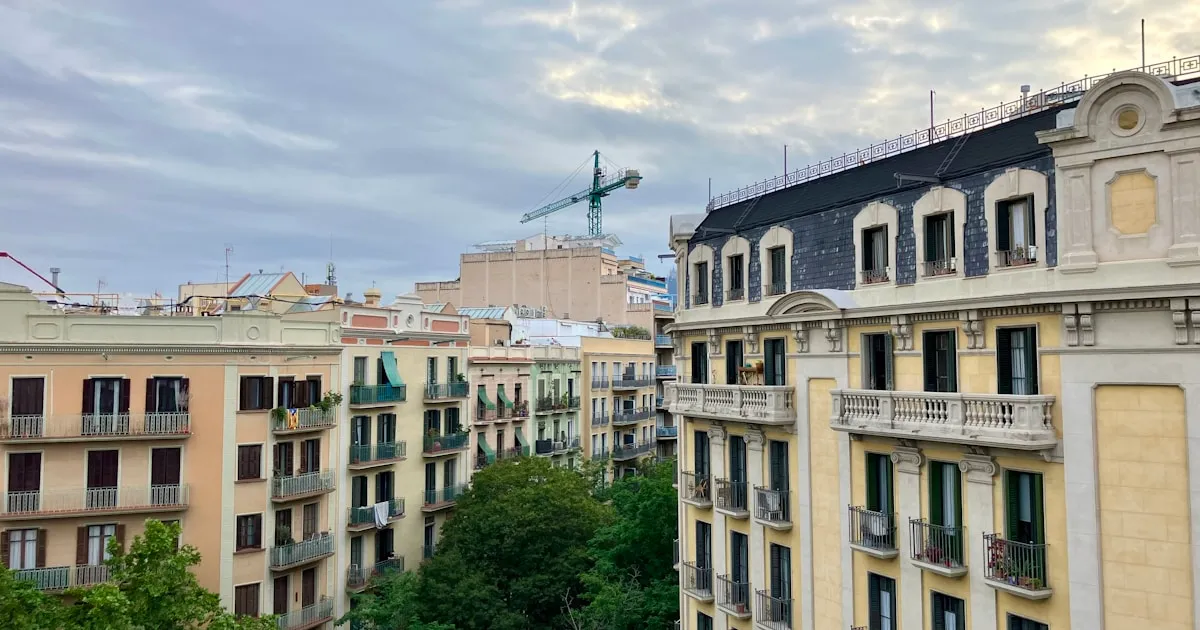
“Barcelona is too expensive” is a statement I hear constantly. It is also useless for making any real decision. Saying Barcelona is expensive is like saying Europe is expensive — technically true, meaningless in practice. In February 2026, Sarrià-Sant Gervasi was trading at 6,949 €/m² while Nou Barris sat at 2,976 €/m². That is a 2.33x difference between the most and least expensive districts in the same city, under the same regulations, in the same market. With a budget of €300,000 you can buy 43 m² in Sarrià or 100 m² in Nou Barris. That is not a nuance — it is an entirely different life decision.
This guide is my answer to the question clients ask me week after week: where does the market stand right now, district by district? I have been working this city for over twenty years. What follows is not a summary of headlines. These are verified figures cross-referenced with what I see daily in viewings, negotiations, and closings.
Q1 2026 Market Snapshot: Average Barcelona city price stands at 5,148 €/m² per Idealista (January 2026), with closing prices typically 4–8% below asking. The gap between the most expensive district (Sarrià-Sant Gervasi, 6,949 €/m²) and the most affordable (Nou Barris, 2,976 €/m²) is 2.33x. Transaction volume is rising strongly in Sarrià (+16.78% YoY) and Nou Barris (+15.05%).
Why Price Per Square Metre Can Mislead You
The first mistake buyers and sellers both make is treating asking prices and closing prices as the same number. They are not. They measure two different points in the same transaction, and conflating them can cost tens of thousands of euros.
In Barcelona, the average residential price in 2026 ranges from 4,631 €/m² per Fotocasa (adjusted closing prices) to 5,148 €/m² per Idealista (January 2026 asking prices). The 11% gap is not a data error — it reflects two distinct moments in the sales chain. The actual transaction price falls between the two, with a typical discount of 4–8% off the asking price.
The practical implications are concrete. When the Colegio de Registradores publishes its Q3 2025 closing data — the prices at which deeds were actually signed — the figures consistently fall below Idealista’s asking prices for the same period: Sarrià-Sant Gervasi closed at 6,661 €/m² versus an asking of 6,949 €/m²; Eixample at 6,210 €/m² versus 6,363 €/m²; Gràcia at 5,354 €/m² versus 5,453 €/m². The spread runs between 3% and 5% depending on the district — money you either save or leave on the table depending on how you negotiate.
The second mistake is treating the district’s average price per square metre as a reliable proxy for any specific property. Within the Eixample, a renovated top-floor exterior flat in Sant Antoni and an unrenovated interior ground-floor in the Esquerra may share the same postcode and differ by 1,500–2,000 €/m². When a client arrives with a comparative analysis pulled from a portal, I give them the same response every time: those figures are where the conversation starts, not where it ends.
What district averages do give you is directional positioning. If the property you are being shown is 15% above the district average with no clear differentiating features — full renovation, high floor, exterior-facing, lift, terrace — there is negotiating room. If it is in line with the average and has been live for under four weeks, the room is far narrower.
One factor rarely mentioned in market analyses is the impact of property condition on effective closing price. A renovated flat in a mid-range district can exceed the district’s average price per m², while a property needing a full refurbishment may close 20–30% below it. The neighbourhood sets the floor; the flat’s condition sets the ceiling. For a breakdown of how renovation affects net proceeds, our guide on whether to renovate before selling gives you the numbers before you commit to either path.
Barcelona Price Map 2026: All 10 Districts Ranked
This is the complete market picture as of February 2026, with Idealista asking prices and gross rental yield estimates by district:
| District | Avg. price €/m² | YoY change | Gross rental yield |
|---|---|---|---|
| Sarrià-Sant Gervasi | 6,949 | +14.2% | 3.5–4.0% |
| Eixample | 6,363 | +8.7% | 4.0–4.5% |
| Les Corts | 6,274 | +10.7% | 4.0–4.5% |
| Gràcia | 5,453 | +7.0% | 4.5–5.0% |
| Ciutat Vella | 5,045 | ~+9.5% | 4.5–5.0% |
| Sant Martí | 4,885 | ~+14.1% | 5.2% |
| Sants-Montjuïc | 4,496 | +8.6% | 6.0% |
| Horta-Guinardó | 3,908 | +9.8% | 5.5–6.0% |
| Sant Andreu | 3,787 | +9.1% | 6.2% |
| Nou Barris | 2,976 | +14.5% | 6.5% |
Sources: Idealista monthly Barcelona report, published 4 March 2026 (February 2026 data); Parlantia, rental yield by district.
A few observations on what these numbers reveal beyond the table:
The premium tier (Sarrià-Sant Gervasi, Eixample, Les Corts) operates under a different logic to the rest of the city. Active international demand — French, British, and Latin American buyers remain very relevant in Sarrià — partially insulates these districts from Spanish mortgage rate cycles. The 2022–2023 rate rises hit them less hard than mid-range districts because a meaningful share of their transactions are all-cash or privately financed.
The mid-range tier (Gràcia, Ciutat Vella, Sant Martí) is where competition for well-located stock is most intense. Sant Martí, driven by the 22@ technology district and the demand from tech workers, has grown ~14.1% year-on-year and is now within range of overtaking Gràcia in average price. Any owner in Poblenou or Camp de l’Arpa who is considering selling should take note of this trend.
The affordable tier (Sants-Montjuïc, Horta-Guinardó, Sant Andreu, Nou Barris) is where the most interesting investment dynamics are playing out. Nou Barris — historically Barcelona’s most overlooked market — posted 14.5% annual price growth, the highest percentage gain in the city, alongside a 15.05% increase in transactions per Colegio de Registradores data compiled by BCN Advisors for the January–September 2025 period.
For the best balance of entry price, appreciation rate, and rental yield, Sant Andreu and Sants-Montjuïc currently offer the strongest ratio. Reasonable entry prices, developing infrastructure, and yields roughly double those of the Eixample. Poblenou (Sant Martí) is the alternative for buyers with a more prime profile who want exposure to the tech ecosystem.
Where Properties Sell Fastest: The Ranking That Surprises
Days on market is arguably the most honest indicator of actual market conditions in any given area. You can price a property however you like, but the market tells you how long it holds before you have to cut.
Average time to sell in Barcelona varies substantially by district. In 2026, Sant Antoni and the Eixample lead the turnover ranking at 35–50 days for correctly priced properties. At the other end, Sarrià-Sant Gervasi takes 60–90 days due to its more selective buyer profile.
Here is the data point that surprises almost everyone I share it with: the neighbourhood with the fastest sales in all of Barcelona is not Sant Antoni, not the Dreta de l’Eixample, not any of the city’s Instagram-trending areas. It is Vilapicina i la Torre Llobeta, in Nou Barris. At a median of 22 days, it is the highest-turnover neighbourhood in the city according to Parkrose Properties, drawing on Tecnocasa, UPF, and Housfy data.
Two cases illustrate the underlying dynamic clearly:
Case A: A 65 m² flat in Sant Antoni (Eixample), fully renovated, second floor, exterior-facing with balcony. Asking price: €420,000. Sale time: 35 days. Closing price: €405,000 (3.6% discount).
Case B: A 65 m² flat in Nou Barris, decent condition but unrenovated, fourth floor with lift. Asking price: €195,000. Sale time: 70 days. Closing price: €183,000 (6.2% discount).
The Nou Barris flat took twice as long to sell — but it sold within a neighbourhood whose average turnover ranks among the city’s fastest. The difference was entry price. Case B launched 8% above what the neighbourhood would absorb at that moment. Once the price was adjusted, it sold in 70 days. Had it been priced correctly from the start, it likely would have closed in 40–45 days.
The full neighbourhood ranking, based on 2025–2026 available data:
| Area | Median days to sell |
|---|---|
| Vilapicina i la Torre Llobeta (Nou Barris) | 22 |
| Vallcarca i els Penitents | 27 |
| El Congrés i els Indians (Sant Andreu) | 28.5 |
| Sant Antoni (Eixample) | ~35 |
| Sarrià-Sant Gervasi | ~38–60 |
| Gràcia | ~31–42 |
| Eixample Dreta | ~45 |
| Sants-Montjuïc | ~58 |
| Nou Barris (district average) | ~65–75 |
| El Coll (Gràcia) | 167 |
| L’Antiga Esquerra de l’Eixample | 166 |
Source: Parkrose Properties, based on Tecnocasa/UPF/Housfy data. City-wide average: 68–77 days.
The practical takeaway: speed of sale depends primarily on entry price, not on the neighbourhood’s brand value. A correctly priced property in any Barcelona district sells faster than an overpriced one in the best location. For a read on the signals that indicate when the market in your specific area is most receptive, see our analysis of market timing signals for selling.
Emerging Neighbourhoods: Where to Invest Today for Tomorrow’s Returns
When I refer to emerging neighbourhoods, I mean areas with concrete, measurable catalysts that justify above-average appreciation over the next five years — not declining zones being dressed up for sale. Four are worth close attention:
Sant Andreu trades today at 3,787 €/m², making it one of Barcelona’s most affordable districts with direct metro access. The real catalyst is the La Sagrera intermodal hub, which will connect high-speed rail (AVE), metro lines L9/L10, and four new planned stations, with full opening estimated for 2031–2032. Infrastructure of this scale typically starts moving nearby prices several years before completion, as buyers anticipate the connectivity improvement. Between 2021 and 2024, Sant Andreu already accumulated 20.31% in price appreciation. That trajectory is not a coincidence.
Poblenou and the 22@ (within Sant Martí) represent the most successful urban transformation story in Barcelona over the past two decades. Average prices in Poblenou stand at approximately 4,351 €/m² with 11.8% year-on-year growth, and since the 22@ project began the cumulative appreciation exceeds 50–70%. The demand driver is structural: tech ecosystem workers — many earning dollar or international euro salaries — prefer living close to the office, which sustains both purchase and rental markets.
La Marina del Prat Vermell (Sants-Montjuïc) is Barcelona’s most ambitious live urban transformation project. Entry prices currently sit at 3,572–3,644 €/m², but the plan includes 12,000 new homes and a doubling of the neighbourhood’s population from 30,000 to 60,000 residents. In February 2025, 424 subsidised housing units were approved in Sector 6. Cumulative appreciation since the transformation began already exceeds 147%. For an investor with a seven-to-ten-year horizon, execution risk exists — as with any urban development project — but the appreciation potential is the highest in the city.
Camp de l’Arpa del Clot (Sant Martí) is the more conservative option: an established residential neighbourhood, priced at roughly 3,800–4,000 €/m², with 10–18.5% annual appreciation and proximity to the centre without Eixample pricing. For buyers seeking investment returns without urban development risk, this neighbourhood’s risk-return profile is hard to beat.
As Cristina Arias, Director of Research at Tinsa, noted in the IMIE Q4 2025 report: “Where demand for new-build housing is in deficit, demand migrates from one segment to another, driving absorption of second-hand stock and making it scarcer — which explains the sharper price growth seen in the most recent period.” This is exactly what is playing out in Sant Andreu and La Marina: new supply is scarce, and resale stock is absorbing demand that has nowhere else to go.
For buy-to-let investors in Barcelona in 2026, the average gross yield is 5.7%, but the spread by district is decisive: Nou Barris leads with up to 6.5% gross, followed by Sant Andreu at 6.2%. Prime districts offer lower income returns but greater stability: Sarrià-Sant Gervasi yields around 3.5–4.0% gross. If rental income is the objective, the most favourable equation sits in the Sant Andreu–Nou Barris–Sants arc. If capital preservation with lower regulatory exposure is the priority, Eixample and Les Corts remain the benchmark. For a detailed analysis of long-term rental returns, see our long-term return analysis.
How to Read the Price Map (and Avoid the Costliest Mistakes)
Having the data in front of you does not guarantee sound decisions. I have watched buyers with meticulous spreadsheets make €50,000 errors because they focused on the district’s price per m² and ignored everything else.
Five variables, combined with district pricing, determine the real value of any specific property — none of which the portals will tell you:
- Distance to the nearest metro stop (direct impact on price and days to sell)
- Property condition: fully renovated adds 20-30% over the district average price per m²
- Floor and orientation: exterior vs interior, high floor vs low (up to 15% difference)
- Monthly community fees and IBI property tax (can total €300-500/month in buildings with lift and concierge)
- Building energy rating: properties rated E or F face a 5-10% price discount
On the first point: in Barcelona, each additional 200 metres from the nearest metro stop correlates with a 3–5% price discount. The relationship is not perfectly uniform across all neighbourhoods, but it is consistent enough to factor into any valuation.
On property condition: the premium for a quality renovation in Barcelona runs 20–30% above the district’s average price per m². A flat in Gràcia, where the district trades at 5,453 €/m², can close at 6,500–6,800 €/m² if it is fully renovated with quality materials and a high energy rating. The flat next door, unrenovated, may close at 4,300 €/m². Both appear in the same district average.
The most expensive mistake I see repeated — and I have seen it enough times to flag it explicitly — is buying a flat at “district price” without checking the community fees. In Eixample buildings with lift, full-time concierge, and communal pool, community charges can exceed €300–400 per month. Combined with IBI property tax, that is €4,000–5,000 per year in fixed costs before a single euro of mortgage. It changes the real cost of ownership materially.
Energy certification will carry increasing weight over the coming years. European directives are tightening on this front, and more informed buyers — particularly international ones — are already applying 5–10% discounts to E- or F-rated properties. This is not arbitrary: it is anticipating regulation that is already in motion. If the building you are evaluating has a poor energy certificate, price that discount into your offer; do not overlook it.
My Professional Assessment: What’s Coming in 2026-2027
Twenty-plus years in this market have taught me that precise forecasts are an illusion. But Barcelona’s structural data points in a fairly clear direction.
The macro context is supportive: BBVA Research forecasts 5.3% national price growth for 2026, and Barcelona historically outperforms that average. The more decisive factor for Barcelona, however, is not the interest rate cycle — though ECB cuts are a tailwind — it is the structural imbalance between housing supply and demand.
Catalonia produces approximately 15,000 new homes per year. It needs 25,000 to meet demand. That annual shortfall of 10,000 units is not a problem that resolves in two years: it is a structural gap that, per APCE and UPF data, has been accumulating since 2008. As long as the gap persists, upward pressure on existing housing stock does not go away — particularly in the districts with the highest demand and the least available land.
My outlook for 2026–2027: moderate but sustained appreciation across the city, with growing divergence between districts. Those with infrastructure catalysts (Sant Andreu, Sant Martí) will continue to outpace the average. Prime districts will keep rising but at a slower pace than in 2024–2025 — they are already at price levels that narrow the pool of potential buyers. Affordable districts will keep posting upside surprises as demand that cannot reach the Eixample searches for viable alternatives.
By buyer profile:
- First purchase, tighter budget: Sant Andreu or Horta-Guinardó. Good connectivity, reasonable entry prices, consistent appreciation.
- Buy-to-let investment: Nou Barris or Sants-Montjuïc. Higher yield, lower entry price. Requires active management.
- Owner-occupier with long horizon: Poblenou (Sant Martí) or Camp de l’Arpa. Mid-range pricing, dynamic environment, sustained appreciation.
- Prime or international buyer: Eixample or Les Corts. Maximum liquidity, lower yield but lower regulatory risk and greater capital stability.
A broad price correction in Barcelona is not something I see on the near-term horizon. For that to happen, you would need a combination of sharp rate rises, a significant increase in new supply, and a decline in external demand. None of those three conditions are present today. What I do see are concrete opportunities in specific districts that the market has not yet fully priced in.
For broader context on the Catalan and Spanish market before making decisions, the complete Barcelona real estate market guide provides the wider framework. And if you have a specific property you want valued with current neighbourhood data, get in touch directly: with twenty years reading this market, there are things the data alone does not capture — and those are the details that matter most when a real decision is on the table.