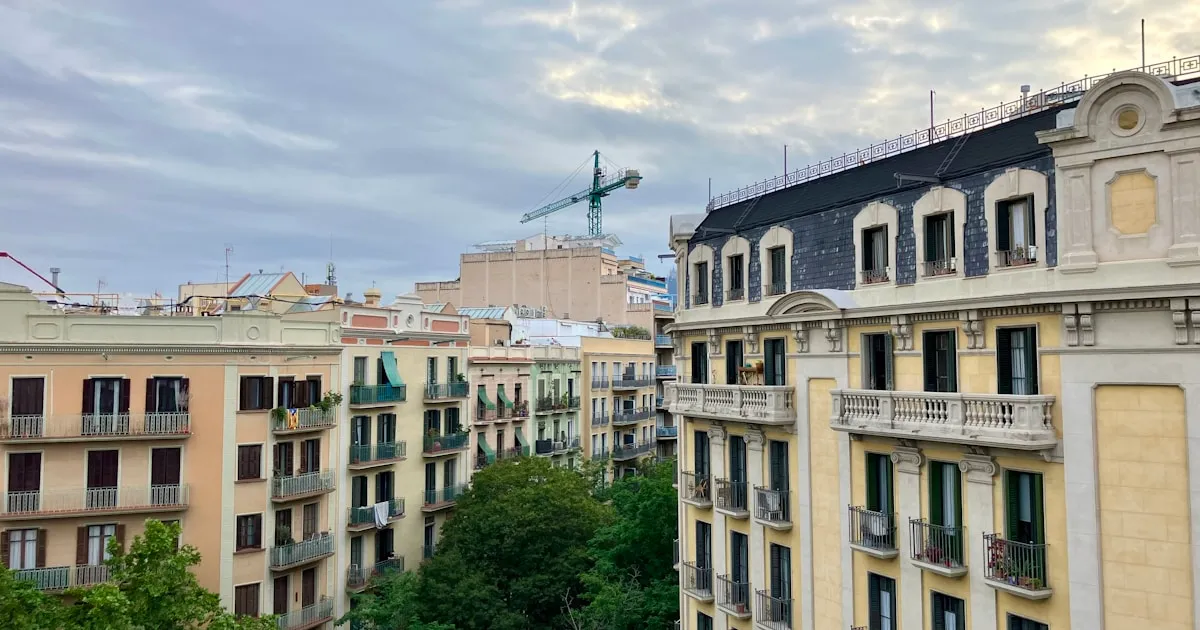



In 2011, an Eixample property owner received an offer of 318,960 euros for their 80-square-metre apartment. Fifteen years later, that same flat is worth 532,240 euros and has generated 155,000 euros in net rental income. The gap between selling and holding exceeds 292,000 euros. This is not a projection. It already happened.
The Owner Who Didn’t Sell in 2011: A 200,000-Euro Decision
The market was in freefall. Headlines spoke of an endless crisis. Spain had been shedding property value for three straight years. Banks were foreclosing, developers were going bankrupt, and no analyst dared to predict a recovery. Any owner who chose to sell was acting rationally: save what you can before it evaporates.
But emotional logic and financial logic don’t always align.
In finance, before launching any investment strategy, professionals run a backtesting analysis: they apply the strategy to historical data to see how it would have performed. Every fund manager does this before risking client money. Strangely, almost nobody applies this same discipline to the most valuable asset most Spanish families own: their home.
That is exactly what this article does. Using real sale prices, rental data and inflation figures for Barcelona, we analyse three historical scenarios: what happened if you sold your apartment in 2011, 2016 or 2021, versus keeping it and renting it out. These are not projections or optimistic estimates. They are numbers that already occurred.
The Wall Street analogy is deliberate. The best investors in the world know that emotions destroy returns: people sell in panic at the bottom and buy in euphoria at the top. In Barcelona’s property market, this pattern has played out with mathematical precision over the past 15 years.
This article looks backwards. If you want forward-looking simulations with 5 and 10-year projections, see our companion piece: Sell or Rent My Apartment in Barcelona: Real Simulations 2026. Together, these two articles form a pair: what happened (this one) and what might happen (that one).
Historical Overview: Sale and Rental Prices (2011-2026)
Before running any simulations, we need to understand how the two key indicators evolved: the sale price and rental price per square metre across Barcelona’s main districts.
Sale prices: from crisis floor to 2026 ceiling
Barcelona’s property market bottomed out between 2013 and 2014, following the financial crisis that began in 2008. Since then, recovery has been uneven but sustained. By 2026, prices exceed pre-crisis highs in every district analysed.
| District | 2011 (euros/sqm) | 2016 (euros/sqm) | 2021 (euros/sqm) | 2026 (euros/sqm) | Change 2011-2026 |
|---|---|---|---|---|---|
| Eixample | 3,987 | 4,100 | 4,770 | 6,653 | +66.9% |
| Gracia | 3,800 | 3,500 | 4,200 | 5,420 | +42.6% |
| Sant Marti | 3,451 | 3,500 | 3,900 | 4,680 | +35.6% |
| Sarria-Sant Gervasi | 4,667 | 4,500 | 5,350 | 7,367 | +57.9% |
| Barcelona average | 3,565 | 3,500 | 4,230 | 5,148 | +44.4% |
Sources: Idealista (asking prices), Spanish Property Insight, INE Land Registry Statistics. Figures for 2016 and 2021 are approximations based on available quarterly data.
Note that Gracia and Sant Marti traded below the city average in 2011 and recovered more slowly at first. Meanwhile, Eixample and Sarria-Sant Gervasi led the appreciation, driven by international demand and limited supply in premium zones.
Rental prices: the other half of the equation
Rents in Barcelona have risen even more sharply than sale prices, particularly since 2016. The combination of growing demand, regulation (which reduced supply) and tourism pushed prices to historic highs.
| District | 2011 (euros/sqm/month) | 2016 (euros/sqm/month) | 2021 (euros/sqm/month) | 2026 (euros/sqm/month) | Change 2011-2026 |
|---|---|---|---|---|---|
| Eixample | 11.5 | 14.5 | 16.0 | 25.5 | +121.7% |
| Gracia | 10.8 | 13.5 | 14.8 | 23.0 | +113.0% |
| Sant Marti | 9.8 | 12.0 | 13.2 | 21.5 | +119.4% |
| Sarria-Sant Gervasi | 11.0 | 13.8 | 15.2 | 24.5 | +122.7% |
| Barcelona average | 10.5 | 13.0 | 14.0 | 23.8 | +126.7% |
Sources: Idealista, Gencat Housing Observatory (Incasol deposit data), Barcelona Metropolitan Housing Observatory.
Key inflation figure: Cumulative CPI in Spain between 2011 and 2026 was 34.2% (source: INE). This means rents grew more than three times faster than inflation, while sale prices grew 1.3 times faster. For a comprehensive overview of current conditions, see our Barcelona real estate market guide.
The data tells a clear story: owners who held property in Barcelona over the past 15 years benefited from both asset appreciation and rental income growth. But in concrete terms, how much money does that difference represent? Let’s run the numbers.
Scenario 1 — You Sold in 2011: The Worst Possible Timing
Picture an owner with an 80-square-metre flat in the Eixample. In 2011, the market was in decline. Headlines painted a picture of never-ending crisis. Many owners sold out of fear that prices would fall further. It was understandable: nobody could predict that Barcelona would experience one of Europe’s strongest property recoveries over the following decade.
Let’s see what actually happened if that owner sold in 2011 versus renting out the property for 15 years.
Option A: Sell in 2011
The 80-square-metre flat at 3,987 euros per square metre sold for 318,960 euros. After transaction costs (3% agency commission, municipal capital gains tax, notary and registration fees), the net proceeds were approximately 293,443 euros.
If that money was placed in conservative savings products earning an average of 2% annually over 15 years, the accumulated wealth by 2026 would be 394,979 euros.
Option B: Rent for 15 years
The owner kept the flat and rented it out. Gross rental income grew from 920 euros per month in 2011 to 2,040 euros by 2025. After operating costs (property tax, community fees, maintenance, insurance, vacancy periods) and income tax with applicable deductions, the cumulative net rental income was approximately 155,000 euros.
In addition, the flat is now worth 532,240 euros (80 square metres at 6,653 euros).
| Item | Sell 2011 | Rent 15 years |
|---|---|---|
| Property value / Net sale proceeds | 293,443 euros | — |
| Investment return over 15 years (2% annual) | +101,536 euros | — |
| Cumulative net rental income (2011-2025) | — | +155,000 euros |
| Property value in 2026 | — | 532,240 euros |
| Total wealth in 2026 | 394,979 euros | 687,240 euros |
| Difference | +292,261 euros in favour of renting |
292,261 euros. That is the real gap between selling at the bottom of the cycle and holding the property as a rental. Selling at a market trough is, statistically, the most expensive financial decision a property owner can make. This scenario demonstrates that time in the market matters more than market timing.
In Barcelona, an owner who sold an 80-square-metre Eixample apartment in 2011 for 318,960 euros would have accumulated 687,240 euros by 2026 had they rented it out instead — a difference of 292,261 euros compared to selling and investing the proceeds at 2% annually.
To put that figure in perspective: 292,261 euros works out to 19,484 euros per year the seller left on the table, or 1,624 euros per month over 15 years. That’s equivalent to a second salary, forfeited.
Scenario 2 — You Sold in 2016: Halfway Through the Recovery
By 2016, Barcelona’s market was waking up. Prices had bottomed out in 2013-2014 and recovery was visible, though fragile. Many owners who had weathered five years of crisis decided to sell as soon as they could recoup part of their investment. The trauma of 2008 had left a deep mark: fear of another crash outweighed hope for a full recovery.
This is the profile of the 2016 seller: someone who didn’t panic-sell in 2011, but lacked the conviction — or patience — to wait for a complete recovery.
The psychology trap of the post-crisis seller
There is a well-documented concept in behavioural finance: recency bias. After a prolonged crisis, investors overestimate the probability of it happening again. In 2016, many Barcelona owners acted as if another crash were imminent. The reality was the opposite: between 2016 and 2026, Eixample prices rose 62.3%.
Selling during a recovery out of fear of the next crash created an entire generation of premature sellers. They didn’t sell in panic — they sold with relief. And that emotion cost them dearly.
The scenario 2 numbers
| Item | Sell 2016 | Rent 10 years |
|---|---|---|
| Property value / Net sale proceeds | 301,760 euros | — |
| Investment return over 10 years (2% annual) | +65,998 euros | — |
| Cumulative net rental income (2016-2025) | — | +100,000 euros |
| Property value in 2026 | — | 532,240 euros |
| Total wealth in 2026 | 367,758 euros | 632,240 euros |
| Difference | +264,482 euros in favour of renting |
The flat sold for 328,000 euros (80 square metres at 4,100 euros) and, after 8% transaction costs, the owner received 301,760 euros net. Invested at 2% for 10 years, that sum grows to 367,758 euros.
Meanwhile, the owner who stayed collected 100,000 euros in net rental income and kept a property now worth 532,240 euros. The difference: 264,482 euros.
Notice that the gap between scenarios 1 and 2 is only 27,779 euros (292,261 vs 264,482). This reveals something counterintuitive: the 2016 seller wasn’t much better off than the 2011 seller, despite waiting five extra years. The reason is that Barcelona’s major appreciation was concentrated between 2016 and 2026 — precisely the period both sellers missed.
Myth busted: “I sold in 2016 because at least I recouped part of my investment.” In reality, recouping part while missing 62% of subsequent appreciation was not a good trade. The 264,482-euro gap would have covered a 20% deposit on a second property.
Scenario 3 — You Sold in 2021: Post-Pandemic Uncertainty
If 2011 was about fear and 2016 was about relief, 2021 was about confusion. The pandemic had frozen the market for months. While prices recovered quickly, uncertainty was at peak levels: nobody knew whether remote work would empty cities, whether there would be a second economic wave, or whether rental regulation would crush yields.
Many Barcelona owners sold in 2021 convinced the market had peaked. What followed was the opposite: one of the decade’s sharpest appreciation phases, driven by a chronic shortage of new supply, the return of tourism and a surge of international buyers.
The scenario 3 numbers
| Item | Sell 2021 | Rent 5 years |
|---|---|---|
| Property value / Net sale proceeds | 351,072 euros | — |
| Investment return over 5 years (2% annual) | +36,548 euros | — |
| Cumulative net rental income (2021-2025) | — | +57,000 euros |
| Property value in 2026 | — | 532,240 euros |
| Total wealth in 2026 | 387,620 euros | 589,240 euros |
| Difference | +201,620 euros in favour of renting |
Here, the flat sold for 381,600 euros (80 square metres at 4,770 euros). Net of costs: 351,072 euros. Invested conservatively, that becomes 387,620 euros by 2026.
The owner who rented accumulated 57,000 euros in net income over five years and kept a property now worth 532,240 euros. Difference: 201,620 euros.
Stock market comparison: Had the 2021 seller invested the 351,072 euros in an MSCI World index fund in EUR (which returned approximately 85% between 2021 and 2026), they would have accumulated roughly 649,483 euros, outperforming the owner who rented (589,240 euros). However, that stock market return included a -12.8% drop in 2022 and a level of volatility few property owners would have endured without panic-selling.
Even in the shortest scenario, with only five years on the clock and maximum uncertainty, holding and renting was the more profitable decision. The 39.5% appreciation between 2021 and 2026 in the Eixample exceeded any reasonable expectation at the time. Those who sold in 2021 acted on the best information available, but the market rewarded patience over prudence once again.
The Big Picture: Summary Table and What the Data Reveals
Let’s bring all three scenarios together in a single table to see the full pattern.
| Scenario | Wealth if sold | Wealth if rented | Difference | Annualised extra return |
|---|---|---|---|---|
| Sold 2011 (15 years) | 394,979 euros | 687,240 euros | +292,261 euros | +3.7% per year |
| Sold 2016 (10 years) | 367,758 euros | 632,240 euros | +264,482 euros | +5.6% per year |
| Sold 2021 (5 years) | 387,620 euros | 589,240 euros | +201,620 euros | +8.7% per year |
The annualised extra return column shows the additional return the renting owner earned compared to the seller who invested at 2%. In all three scenarios, renting won.
Across all three scenarios analysed (sales in 2011, 2016 and 2021), holding the property and renting it out outperformed selling in every case, with gaps ranging from 201,620 to 292,261 euros for an 80-square-metre Eixample apartment. The annualised outperformance ranged from 3.7% to 8.7%.
But the most telling detail is this: the advantage narrows as the time horizon shrinks. Over 15 years, the rental advantage was 292,261 euros. Over 5 years, it was 201,620 euros. This confirms a core principle of property investment: time is the greatest wealth multiplier.
As Gonzalo Bernardos, Professor of Economics at the University of Barcelona, stated: “500,000 people are arriving every year. We have population growth similar to what we saw before the housing bubble, and this is not a one-off — it will continue.” This demographic pressure is one of the structural factors that explains why Barcelona appreciated so consistently over 15 years.
For the data enthusiasts: Adjusting for inflation (34.2% cumulative CPI between 2011 and 2026 per the INE), the 293,443 euros in net sale proceeds from 2011 are worth just 218,660 euros in 2026 purchasing power. The real, inflation-adjusted gap exceeds 468,000 euros.
Why Historical Data Is Not a Crystal Ball
So far, the numbers are compelling: in Barcelona, holding and renting won in every scenario. But it would be irresponsible to extrapolate this conclusion without caveats.
Survivorship bias
Barcelona is a success story. It’s a city with sustained international demand, supply constraints (regulation, geography, heritage protections) and a professional and tourist appeal that few European cities can replicate. Not all Spanish cities followed this trajectory. Mid-tier cities like Castellon, Ciudad Real or Jaen had not recovered their pre-crisis levels by 2026. An owner who held property in those cities and rented would not have achieved these results.
Barcelona’s unique structural factors
What sets Barcelona apart are factors that cannot be easily replicated:
- Supply constraints: Geography (sea, Collserola hills, neighbouring municipalities) limits expansion. Urban planning regulation slows new construction.
- International demand: Buyers and tenants from across Europe, accelerated by the rise of remote work post-pandemic.
- Diversified economy: Tourism, technology, professional services, universities. Not dependent on a single sector.
- Consolidated infrastructure: Transport, healthcare, leisure. A city that attracts both families and young professionals.
The necessary counterexample
Between 2011 and 2026, the average property price in Spain rose approximately 25% according to the INE. In Barcelona, the increase was 44.4%. This divergence means our backtesting results cannot be extrapolated to the Spanish market as a whole. Backtesting works as an analytical tool, not as a prediction.
Past performance does not guarantee future results. The three scenarios demonstrate that holding property in Barcelona was profitable between 2011 and 2026, but the next 15-year period could be different. Regulatory changes, interest rate shifts or economic crises could alter the equation.
What the data does tell us is that selling during moments of panic or uncertainty has historically been costly, and that Barcelona has structural characteristics that favour long-term appreciation. That is not a guarantee, but it is a solid foundation for decision-making.
5 Historical Lessons for Your 2026 Decision
If you are considering whether to sell or rent out your Barcelona apartment in 2026, the historical data from the past 15 years offers concrete lessons.
1. Sale timing matters less than time in the market. In all three scenarios, even the worst moment (2011) turned into a good outcome if the owner held the property. The difference between selling at the trough and selling during recovery was just 27,779 euros, while the difference between selling and not selling exceeded 200,000 euros in every case. For objective signals on when to sell, see our guide on signs it’s the right time to sell.
2. Transaction costs are a real exit barrier. Roughly 8% of property value evaporates with each sale. In our case study, that amounts to 25,000-30,000 euros. Before selling, calculate whether the alternative justifies that fixed cost.
3. Rental income is more than passive income — it’s an inflation hedge. Rents in Barcelona grew 126.7% between 2011 and 2026, versus 34% for CPI. A rented apartment doesn’t just generate income — it generates income that grows faster than inflation. If you decide to hold, make sure your property is prepared to maximise its appeal with our complete preparation checklist.
4. Barcelona’s appreciation was not an accident. Behind the numbers are structural factors: supply constraints, international demand, a diversified economy. These factors remain in place in 2026. That doesn’t guarantee the next 15 years, but it explains the last 15.
5. If you do sell, invest in maximising the price. The data shows that every euro of appreciation counts. If you ultimately decide to sell, make sure you obtain the maximum for your property. Our analysis of whether renovating before selling is worthwhile can help you make that decision with data.
Your situation is unique. Market averages are useful, but your decision depends on your tax position, time horizon and liquidity needs. If you want a personalised simulation with real data for your property, get in touch for a free, no-obligation valuation.
Sources:
- Idealista — Historical sale and rental price reports by Barcelona district
- INE — Land Registry Statistics and Consumer Price Index
- Gencat Housing — Rental market statistics by district and neighbourhood
- Spanish Property Insight — Historical Barcelona property prices by district
- Bank of Spain — Housing market indicators
- CaixaBank Research — Spain’s housing market enters new expansionary phase
Legal disclaimer: The data and simulations in this article are for informational and educational purposes only. Past returns do not guarantee future results. Consult a tax and financial adviser before making property investment decisions.