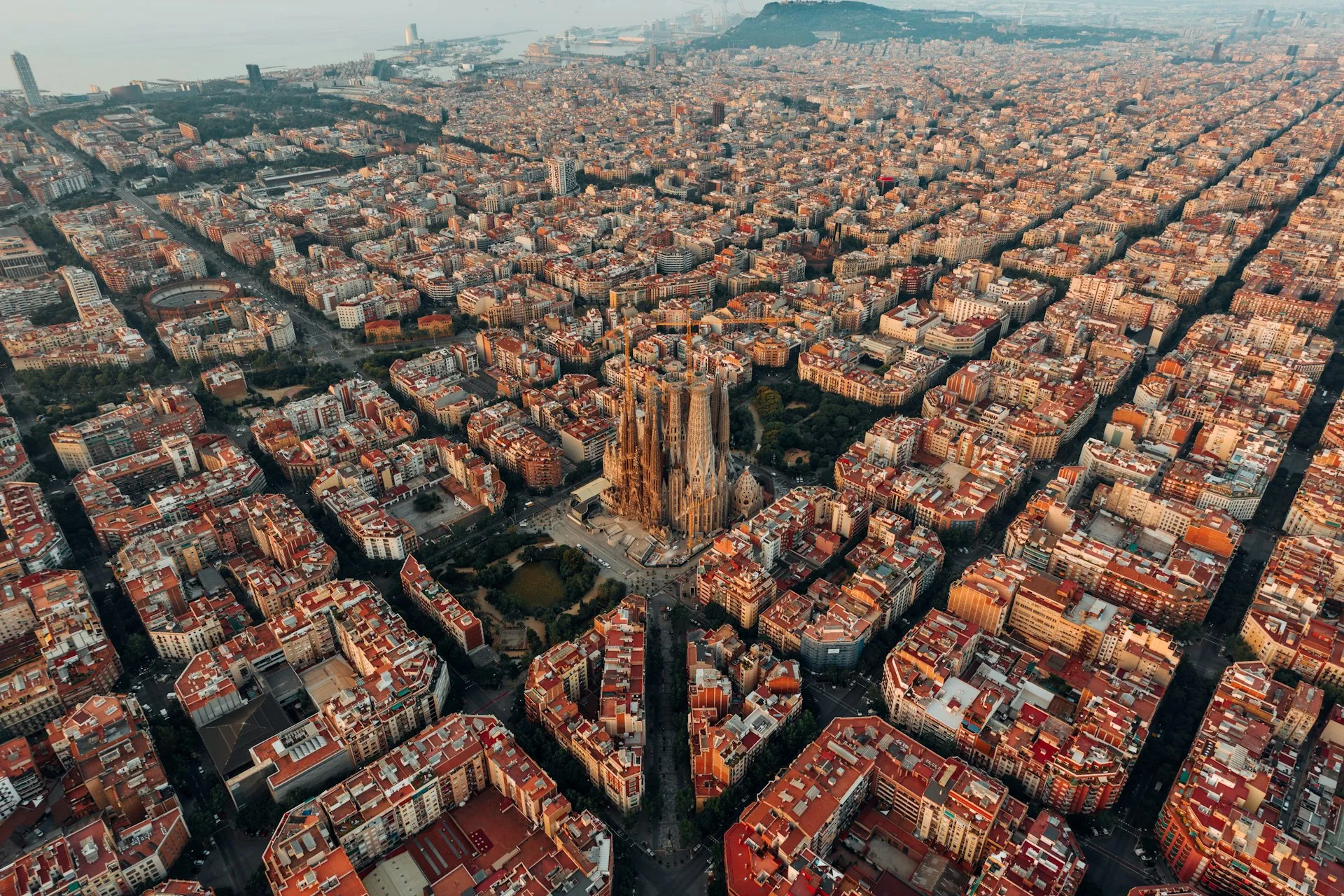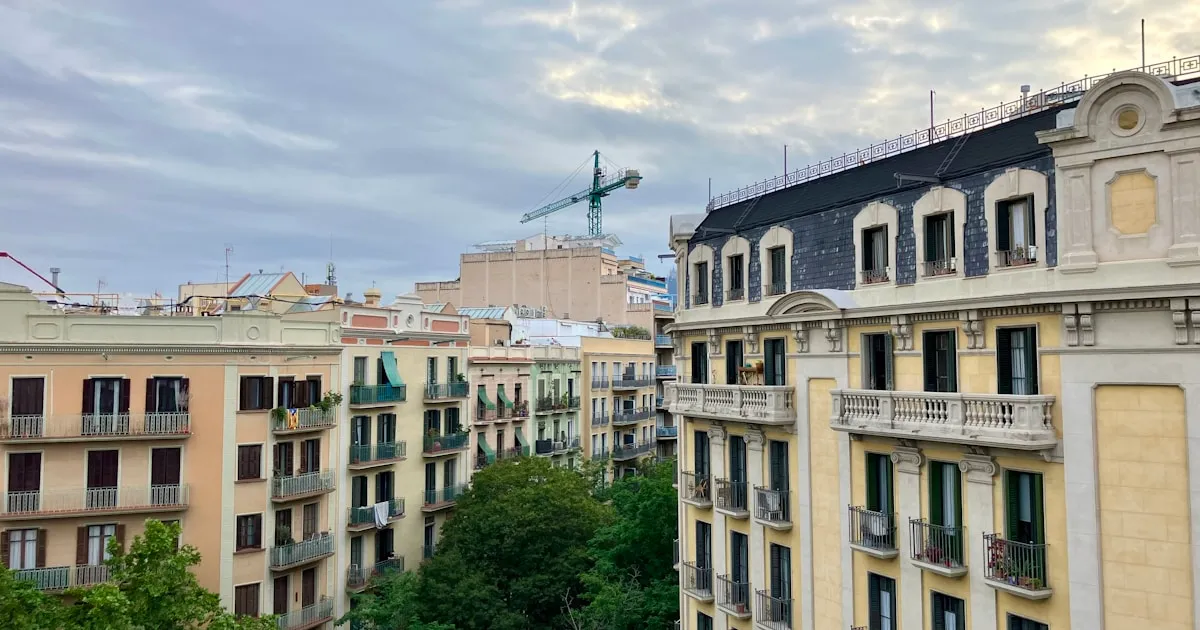


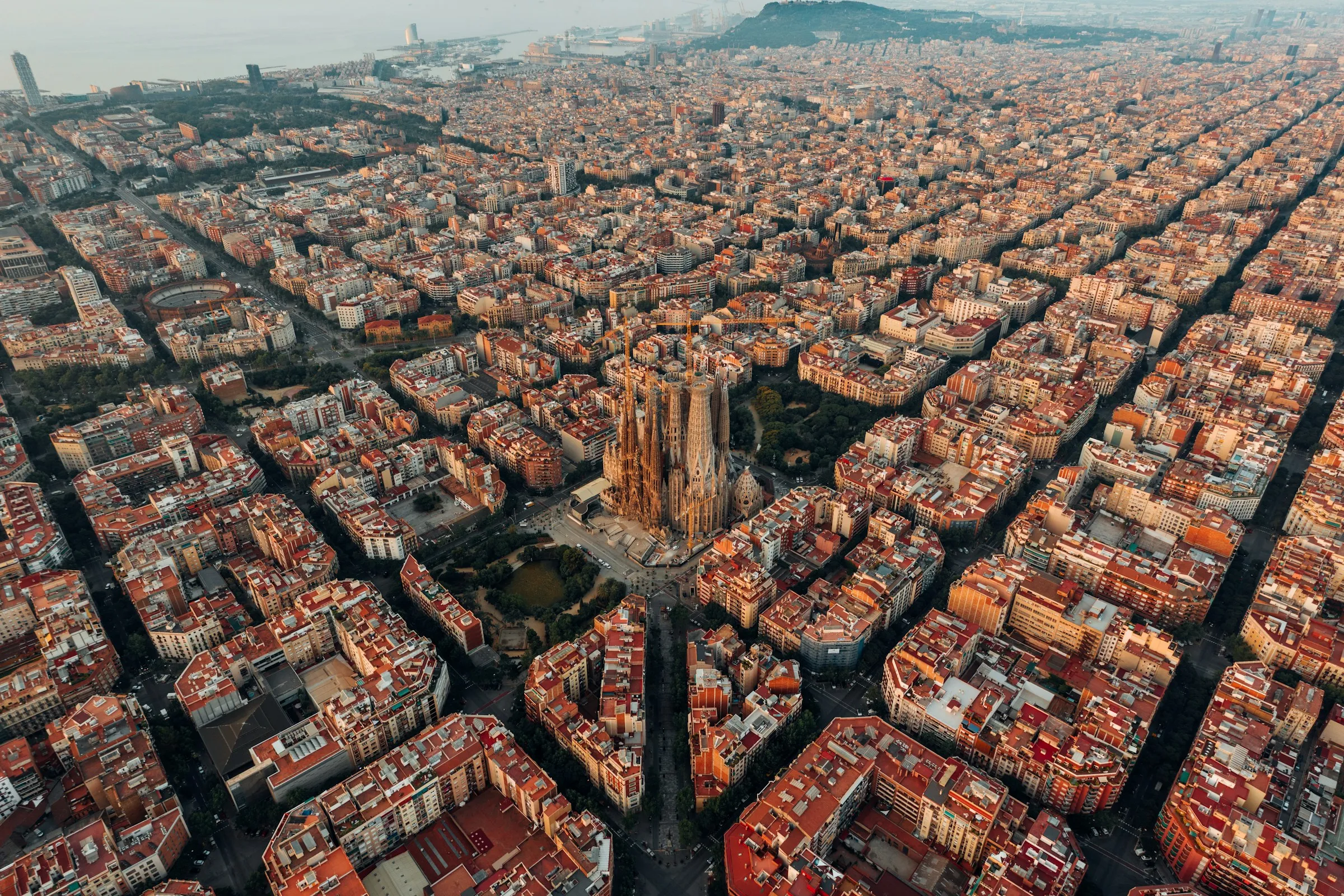
Most buyers look for apartments in neighborhoods they already know. Eixample, Gràcia, Sarrià. Names that sound right, that their friends recognize, that show up in travel guides. Nothing wrong with that, except for one thing: when a neighborhood is already popular, most of its appreciation has already happened. Buying there is safe. But the growth margin is a different story.
Real estate works like any other market: actual returns are captured before the consensus discovers them. Buying property in a neighborhood after everyone is talking about it is like buying a stock after it makes the front page. You might still gain something, but the real jump already went to someone else. In Barcelona, the numbers confirm this. While Sarrià-Sant Gervasi grew 14.2% year-on-year in February 2026, neighborhoods like Sant Andreu accumulated 20.3% appreciation over just three years, starting from a much lower base. That gap is not random. It has identifiable, measurable, and above all, anticipatable causes.
This article examines four areas of Barcelona where the growth catalysts are concrete and already underway. These are not vague predictions. They are projects with allocated budgets, published timelines, and effects already showing up in prices. If you want the full district-by-district price overview, check our Barcelona neighborhood price guide. Here, we go deeper into what is coming next.
What makes a neighborhood “emerge”
Not every affordable neighborhood appreciates. Some have been cheap for decades and stay that way. The difference between a cheap neighborhood and an emerging one comes down to three factors appearing together:
Transport infrastructure under construction or approved. A new metro station or commuter rail line does not push prices up when it opens. It pushes them up when it is announced with a credible timeline. Buyers anticipate improved connectivity and prices move three to five years before the station opens.
Urban planning regulation unlocking land. When City Hall approves a transformation plan with thousands of new housing units, the neighborhood enters an investment cycle that attracts services, retail and population. Vacant or industrial land becomes residential.
Demographic displacement. Young families and professionals who cannot afford established neighborhoods move to adjacent areas. They bring purchasing power, open businesses and change the composition of the neighborhood within a generation.
When all three factors coincide, you have a genuine emerging neighborhood. When only one is present, you have a cheap area with good intentions.
This article complements our Barcelona neighborhood price guide 2026, which provides the complete district-by-district price map. Here we go deeper into the four areas with the highest appreciation potential and the catalysts behind them.
Sant Andreu and La Sagrera: the transformation already started
Sant Andreu sits at 3,787 euros per square metre as of February 2026, making it one of Barcelona’s most accessible districts with direct metro access. But today’s price is only half the story. Between 2021 and 2024, the district accumulated 20.3% appreciation according to Idealista data. That pace exceeds the city average and has a concrete explanation: the La Sagrera intermodal station.
La Sagrera will be Catalonia’s largest station when fully operational. It will connect high-speed rail (AVE) with metro lines L9 and L10, Rodalies commuter trains and intercity buses. Total investment exceeds 1.5 billion euros (1.27 billion from Adif for rail infrastructure alone, plus 260 million from City Hall for urban transformation). Since March 2025, high-speed trains are already running through the station structure: 4 of 10 AVE tracks are operational, carrying roughly 34 trains per weekday. Metro stations L9/L10 at La Sagrera are expected by 2027, with full intermodal complex opening between 2031 and 2032.
What most buyers fail to calculate is that the price impact does not wait for the opening ceremony. In Madrid, the area around Chamartín station started appreciating six years before the full renovation of Madrid Nuevo Norte. The same thing is happening in Sant Andreu. The redevelopment of Bon Pastor, with 1,500 new housing units replacing the old “casas baratas” social housing, is physically transforming the area. Each new development delivered arrives with prices 8-12% higher than the previous one.
For investors, Sant Andreu offers a gross rental yield of 6.2% today, the second-highest in Barcelona after Nou Barris. With the intermodal station on the horizon, the risk-return profile is among the most attractive in the city. This is not speculation: it is infrastructure with a timeline and budget.
Poblenou and 22@: what already emerged and what remains
Poblenou is the mandatory reference when discussing urban transformation in Barcelona. An industrial neighborhood that in two decades went from abandoned factories to hosting southern Europe’s largest technology ecosystem. The average price in Poblenou is around 4,351 euros per square metre as of February 2026, with year-on-year growth of 11.8%. Since the 22@ project began, cumulative appreciation in the most transformed areas exceeds 50-70%.
Now the uncomfortable question: if 22@ has already transformed, if prices are up 70%, if Amazon, Meta and dozens of startups are already there… is it still an “emerging” neighborhood?
The honest answer is that the 22@ core is not. A square metre at 4,300-4,500 euros in a zone with top-tier tech offices is not emerging: it is a consolidated neighborhood priced accordingly. The opportunity has shifted to the edges. Streets north of 22@, toward Sant Martí de Provençals, and south toward the Fòrum, maintain prices 500 to 800 euros per square metre below the core. And every year, the tech ecosystem expands toward those areas.
The structural factor keeping demand alive is salary-driven. Tech workers in Barcelona earn between 45,000 and 85,000 euros annually, many at international companies paying above local market rates. These professionals prefer living close to the office and can sustain rents of 1,200-1,800 euros per month. That will not change as long as 22@ keeps attracting companies, and all signs point to it continuing.
If you are considering Poblenou as an investment, look toward the margins. The 22@ core has already delivered its returns.
La Marina del Prat Vermell: what Poblenou was ten years ago
Imagine someone had told you in 2005 that an industrial neighborhood next to Gran Via, with barely any shops or services, would triple its prices in fifteen years. You would have laughed. That is exactly what happened in Poblenou. La Marina del Prat Vermell is today where Poblenou was then, with one difference: the urban development plan is even more ambitious.
La Marina starts at entry prices of 3,572-3,644 euros per square metre within the Sants-Montjuïc district. The transformation plan calls for 12,000 new housing units, aiming to double the neighborhood’s population from 30,000 to 60,000 residents. In February 2025, City Hall approved 424 social housing units in Sector 6, the key development piece. Cumulative appreciation since the transformation began already exceeds 147%.
The numbers are attractive, but the timeline is long. We are talking about an urban transformation project that will take seven to ten years to complete. Sector 6 housing units will not be delivered before 2029-2030. Execution risk exists, as with any development at this scale: permit delays, changes in city government, neighborhood opposition to increased density.
La Marina is a seven-to-ten-year play. If you need short-term liquidity or cannot absorb two-to-three-year delays in the urban development timeline, this area is not for you. The appreciation potential is the highest in the city, but it comes with proportional uncertainty.
For those with patience and capital, La Marina offers something the rest of Barcelona no longer has: developable land in a district with good connectivity (metro lines L1 and L3 minutes away), still-accessible entry prices and a development plan with committed public funding.
El Besòs i el Maresme: twenty years after the Fòrum
The 2004 Fòrum de les Cultures was supposed to transform Barcelona’s northeastern edge. That was the promise. Two decades later, the transformation happened, but slower and more unevenly than predicted. Diagonal Mar established itself as a premium residential zone, with closing prices exceeding 5,500 euros per square metre and asking prices approaching 9,200 euros for waterfront towers (it is the most expensive neighborhood in all of Catalonia according to Idealista data). But just 800 metres inland, El Besòs i el Maresme records closing prices around 3,100 euros per square metre, with 19.5% growth in the first half of 2025 according to Punto Habitat. A single district (Sant Martí) averaging 4,885 euros contains, within two kilometres, Barcelona’s largest price disparity.
The Superilla del Besòs and the urban regeneration plan are the current catalysts. In March 2026, City Hall agreed on a 15-million-euro investment for urban regeneration of El Besòs i el Maresme, covering facade rehabilitation, public space improvements and new relocation housing. The superblock project transforms public space, reduces road traffic and creates pedestrian and green zones that change how the neighborhood is perceived. Barcelona has been implementing superblocks for a decade, and the pattern is consistent: each completed superblock generates a price increase of 5-10% in its surrounding area within three years.
The other factor is proximity to the sea. El Besòs has direct access to Barcelona’s waterfront, something it shares with Barceloneta and Vila Olímpica, where closing prices sit around 5,800 euros per square metre. The gap between El Besòs (3,100 euros) and Vila Olímpica (5,800 euros) exceeds 2,700 euros per square metre for areas separated by less than two kilometres. That gap has a natural ceiling: as the neighborhood improves, the differential will compress.
The risk here is about pace, not direction. El Besòs will keep improving. The question is whether it happens in five years or fifteen.
Comparison: five areas, five investment profiles
| Area | Current price (euros/sqm) | Recent appreciation | Main catalyst | Gross yield | Timeline | Risk |
|---|---|---|---|---|---|---|
| Sant Andreu | 3,787 | +20.3% (2021-2024) | La Sagrera station | 6.2% | 3-5 years | Medium |
| Poblenou / 22@ | 4,351 | +11.8% year-on-year | 22@ tech ecosystem | 4.8% | Maturing | Low |
| La Marina (Sants-Montjuïc) | 3,572-3,644 | +147% cumulative | Sector 6, 12,000 units | 5.5% | 7-10 years | High |
| El Besòs i el Maresme | ~3,100 | +19.5% (H1 2025) | Superilla + regeneration | 5.3% | 5-7 years | Medium-high |
| Diagonal Mar | 5,500+ | +10-12% year-on-year | Established waterfront | 3.8% | Established | Low |
Sources: Idealista (asking prices, February 2026), proprietary transaction data. Gross yield calculated on current market rents. For the full district price map, see our price guide.
The table makes it clear that no single answer exists. Sant Andreu offers the best balance between upside potential and reasonable timeline. La Marina has the highest ceiling but requires patience. Poblenou has already delivered most of its appreciation and now works better as a stable investment than a growth play. Diagonal Mar is the conservative option with waterfront exposure.
What can go wrong (and why not every emerging neighborhood delivers)
It would be irresponsible to talk only about potential without talking about risk. In my twenty-seven years working in Barcelona, I have seen “emerging” neighborhoods that took twice as long as expected to transform, and others where the transformation simply never arrived.
The three main risks are specific. First, infrastructure delays. La Sagrera has accumulated over a decade of delays. The current timeline (2031-2032 for full opening) already incorporates revisions, but further delays cannot be ruled out. Second, rent regulation. Catalonia has a rental price reference index that limits increases. For buy-to-let investors, this regulation reduces expected returns and is a factor that headline data does not capture. Third, neighborhood opposition. Ambitious urban plans generate resistance. In La Marina, neighborhood associations have voiced concerns about densification and the impact on public services. These processes can slow permits and modify projects.
Gonzalo Bernardos, professor of Economics and director of the Real Estate Advisory Master’s at the University of Barcelona, puts it bluntly: “In large cities, it will be easier to sell property in working-class districts than in upscale neighborhoods, and prices will rise more in the former than in the latter.” He goes further: “The best property investment is buying in a half-built neighborhood that doesn’t have complete services yet.” His thesis is backed by CaixaBank Research data, whose principal economist Judit Montoriol notes that “we see this phenomenon very clearly in Barcelona, where part of the demand is shifting toward the periphery” and that “price growth will accelerate even further in municipalities somewhat farther from the center.” They are right about the general thesis, but each neighborhood has its own risk profile that deserves case-by-case analysis.
Your next step
Barcelona’s emerging neighborhoods are not a secret. The data is there for anyone who wants to read it. What separates those who buy well from those who arrive late is the ability to distinguish a real catalyst from an urban planning promise without a timeline.
If you are evaluating an investment in any of these areas, we can help with a specific analysis of the property you are considering: actual closing prices on the specific street, yield projections and risks specific to each deal. Get in touch for a no-obligation consultation.
And if you are still deciding between selling your current property or renting it out before making the move, our backtesting analysis with real data will give you the numbers you need to decide with confidence.