


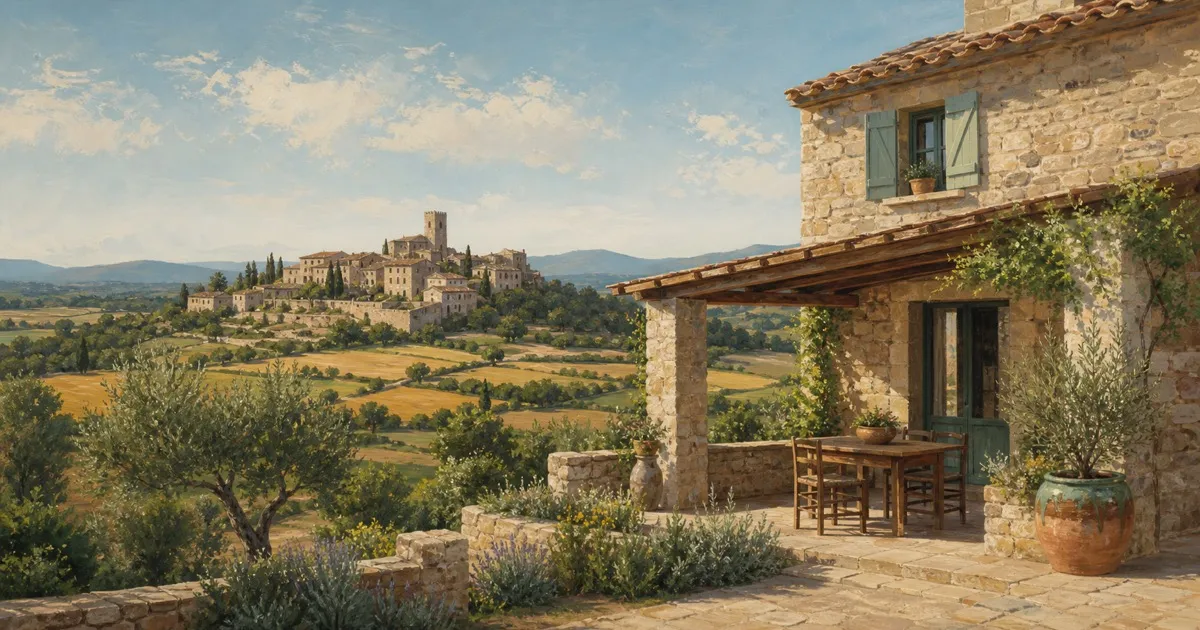
Buying a house in Castell d’Empordà is a choice for a particular kind of daily life: a small historic setting near La Bisbal d’Empordà, with the practical centre of town close by but not at the front door. It is not a substitute for living in Girona or Barcelona, and it should not be sold that way. The sensible question is whether the pace, access and maintenance profile suit the way you will use the house.
For a buyer who wants a village house with outdoor space and can accept a car-centred routine, Castell d’Empordà can make sense. Start by assessing access, then move to the condition and legal description of the individual property. Visit La Bisbal lists a family-level hiking route to the medieval core of Castell d’Empordà, while its access page places La Bisbal 150 km from Barcelona by road and 55 km from Girona Costa Brava Airport (hiking information, access information).
This is a local guide, not personal legal, tax, mortgage or investment advice. A purchase contract, tax position, planning status and building condition need to be checked for the particular house by the professionals who advise you.
Start with the place, not the listing
Castell d’Empordà belongs to the local orbit of La Bisbal d’Empordà. That distinction matters. The setting offers separation from the busier town, but your errands, rail connection and many services will still be organised around La Bisbal and the wider Baix Empordà.
The official tourism office presents Castell d’Empordà as a medieval core on one of three simple, family-level walking routes that start in La Bisbal (route description). It also describes La Bisbal’s cultural offer through crafts, shopping, ceramics, heritage, markets and historic sites (local cultural guide). That does not turn the hamlet into a fully serviced town. It tells you where the local reference points are.
Walk it at the time you would normally come home. A property can feel wonderfully quiet at midday and awkward after dark if the last stretch, parking arrangement or arrival route makes you hesitate. Notice the surfaces underfoot, the width of the approach, where guests would stop and whether a delivery, tradesperson or emergency vehicle could reach the house without improvisation.
The phrase “near La Bisbal” should therefore lead to practical questions. How often will you need the town? Does your household need a reliable school run or rail connection? Are you comfortable coordinating repairs when you are away? A buyer who wants a quiet second home may answer yes to all of that. Someone who needs to walk daily to shops may be looking in the wrong place.
Access is part of the property decision
La Bisbal is 150 km from Barcelona by road, Girona Costa Brava Airport is 55 km away, and Flaçà is identified as the nearest railway station at 12 km from La Bisbal. Visit La Bisbal gives those figures and describes the Barcelona-Portbou train connection to Flaçà, followed by local bus service (how to get there). The same office’s walking information makes clear that Castell d’Empordà is considered within La Bisbal’s municipal walking territory, rather than a separate transport hub (walking routes).
Those figures help you frame the map, but they are not a commute calculation. Your actual door-to-door experience depends on the house’s position, parking, traffic, seasonal demand, weather and the connection you choose after reaching Flaçà. The difference between an easy trip and a tiring one often sits in the final kilometres, not in the headline distance.
Try two versions of the journey before offering on a house. Do the weekday route that a working household would use. Then do an evening or weekend return, preferably with the same luggage, child seat, pet carrier or groceries that make a real trip less elegant than a map pin. If you expect visitors, ask them to find the house once without being guided turn by turn.
For international buyers, the rail-and-airport question deserves an extra layer. A connection that works in summer may not feel equally convenient in the winter or for an early flight. Check current operator schedules separately; the tourism page is a location guide, not a guarantee of a future timetable. That small act of realism is worth more than a picturesque view at a first viewing.
What La Bisbal contributes to everyday life
The nearby town is not just a place to pick up supplies. Ceramics are part of its public identity and its commercial fabric. The tourism office says La Bisbal became the first World Craft City in continental Europe after a World Crafts Council Europe delegation visited in 2021; it also identifies the Terracotta Museum, ceramicists’ association, ceramics school, specialist shops and a protected Ceràmica de la Bisbal brand as parts of that ecosystem (Craft City information).
The Terracotta Museum holds a permanent collection of more than 10,000 ceramic pieces, tools and utensils in a former factory. That is the museum’s own description, and it is a concrete clue to why pottery is visible in the area’s identity rather than a decorative story attached to it (Terracotta Museum).
Laura Baumann, then vice president of World Crafts Council Europe, described La Bisbal as having a connected public-private craft ecosystem in reporting by 3CatInfo. Treat that as useful local context, not as a prediction about property value. A cultural identity can make a place more legible to a buyer; it does not set a resale price or remove the need to inspect the house.
The practical test is simpler. Spend a weekday morning in La Bisbal. Buy something ordinary, park, have coffee, ask about a service and drive back to the property. A place becomes easier to judge once it has carried a mundane errand. Visit the museum or ceramic shops if that interests you, but do not mistake a pleasant Saturday itinerary for a whole year of living there.
Read a village house as a working building
A village house asks more questions of the buyer than a new apartment with a concierge and a standard plan. The questions are not glamorous: water management, roof history, ventilation, drainage, insulation, heating, electrical capacity, damp, walls shared with neighbours, access for repairs and the boundary between private and communal responsibility.
The right way to inspect is to connect documents with what you see. The Spanish notarial body says the notary obtains cadastral information for the deed and checks consistency with the title and Land Registry information, warning the parties about inconsistencies (notarial property guidance). The Registry’s information page says a nota simple identifies the property, registered right holders and the extent, nature and limitations of registered rights (registry explanation).
A nota simple is informative; a registry certification is the document that formally proves the Registry’s content. The Registry explains that distinction directly (Registry information). The immediate takeaway is not that a buyer should attempt legal analysis alone. It is that you should ask a qualified adviser to compare the current registry information, cadastral description and observed building before contractual commitments make a mismatch expensive.
Make a house-specific list after the first visit. Record every item that the seller says was renovated, every feature that appears original, the age of visible equipment where known, and any area that is inaccessible. Then ask which items are supported by invoices, permits, technical reports or the current description. A renovated kitchen is obvious. The condition of the roof structure or a drainage solution may not be.
For a property with land, be equally plain about use. Does the physical garden match the papers? Is access over land clear? Who maintains edges, walls, drains or tracks? Does the intended use require planning, heritage, environmental or licensing checks? The correct answer depends on the address and proposed works. It is not something this guide can settle from a general description.
A calm due-diligence sequence
The order below is a decision framework, not a replacement for professional advice. It prevents a common mistake: falling in love with the setting and then treating the documents as a formality.
- Confirm the brief. Write down how you will use the house, how often, who will be there and what cannot be compromised. This exposes whether you need walkability, a home office, a ground-floor bedroom, parking, a workshop or a lock-and-leave setup.
- Visit for the routine. Repeat the access test and look at the house when you would normally arrive. Use the local guide to locate the route and nearby reference town, then test the actual trip yourself (access guide, Castell d’Empordà route).
- Request the property evidence early. Your advisers can use current registry and cadastral information, together with the seller’s documents, to identify questions before you negotiate the final terms (notarial guidance, Registry guidance).
- Commission the right technical review. The level of investigation should match the age, construction, condition and alterations of the house. If a finding could change the budget or intended use, obtain the relevant specialist advice before relying on an estimate.
- Price the whole decision. Include purchase taxes, notarial and registry work, finance if any, insurance, urgent repairs, furnishings, travel and an allowance for the first year. The Catalan tax authority distinguishes transactions subject to transfer tax from those subject to VAT and stamp duty (Catalan tax guidance).
- Only then decide on terms. A reservation or deposit should reflect the checks and conditions your legal advisers consider necessary. Do not use a standard online checklist as a substitute for the contract review.
This sequence is deliberately unromantic. It protects the part of the purchase that a beautiful terrace cannot answer.
Budget beyond the asking price
It is tempting to treat the asking price as the number that matters and everything else as a small percentage. That is how buyers end up underfunding a purchase that looked comfortable on paper. The tax treatment alone depends on the transaction: the Catalan tax authority explains that a real-estate transfer may fall under transfer tax when VAT is not payable, while transactions with VAT and a public deed can also involve stamp duty (ATC purchase guidance).
The tax route depends on the transaction and buyer circumstances, so no single percentage should be applied to every Castell d’Empordà purchase. The agency publishes general and reduced treatments subject to conditions; it also distinguishes VAT cases (Catalan tax authority). Have a tax professional calculate the current case before you decide what a house is affordable for you.
The cost list should also contain the items people postpone mentally: registry and notarial work, translations where needed, surveyors or architects, insurance, utilities, a local keyholder or maintenance plan, furnishings, connectivity and the repairs that become apparent only after several visits. None of those costs proves a house is a bad purchase. They are part of the actual price of ownership.
Keep two budgets. The first is the maximum all-in acquisition cost you can bear without eroding your safety margin. The second is a first-year ownership budget that assumes one inconvenient surprise. If the numbers work only when every repair can wait and every journey goes smoothly, the property may be too tight for the life you want from it.
A current example: verify the listing, then verify the house
At the time checked for this guide, POI-0595 is listed for sale at €990,000 in Castell d’Empordà / La Bisbal. The listing states 260 m² built, 230 m² usable, 800 m² of garden land, three bedrooms and three bathrooms; it has been renovated and includes a porch, terrace, garden, cellar, parking for three cars and an E energy rating (property details).
The current POI-0595 listing states €990,000, 260 m² built, 230 m² usable and 800 m² of garden land. It is a useful example of the sort of facts that belong in a first comparison sheet, alongside bedrooms, bathrooms, parking, energy rating and the features that affect maintenance (POI-0595 listing). Availability, price and listing information can change, so confirm them directly before making decisions.
The same discipline applies to every attractive phrase in a listing. “Renovated” should prompt questions about scope, dates and documentation. “Garden land” should prompt a check of boundaries, access and maintenance. “Parking for three” should prompt you to see the manoeuvre, not simply count the spaces. “Energy rating E” is a data point, not an energy-cost forecast for your household.
The local setting changes how these features feel. A porch may be the reason a house works for long stays. A cellar may be useful storage or a maintenance concern, depending on ventilation and moisture. Outdoor space can be liberating, but it also creates work. Put the feature beside the routine it must support and the question becomes clearer.
POI-0595 is a practical reference for comparing a restored village-house brief with your own needs. Review the live listing, then arrange a visit and professional checks before relying on any stated feature or measurement.
What can make the fit wrong
A house can be well presented and still be wrong for the buyer. The usual mismatch is not a dramatic defect. It is a lifestyle assumption that was never tested: expecting rail access to operate like a city station, expecting a small historic setting to have every service within a short walk, or expecting an old house to behave like a low-maintenance new build.
Flaçà is the nearest railway station identified by the local tourism office, 12 km from La Bisbal, so a buyer should plan the final connection rather than assume a walkable rail routine. The tourism office also describes the train-and-bus option from Barcelona through Flaçà (transport details). Its walking guide presents routes from La Bisbal to Castell d’Empordà for leisure, which is a different proposition from everyday rail access (local walking guide).
The limitation is not an argument against the area. It is a screening tool. If you want room, a calmer setting and a life organised around La Bisbal rather than residence in its centre, the trade-off may be exactly right. If you need frictionless public transport, frequent spontaneous city life or a house that can be left unattended for months without a maintenance plan, keep looking until the facts say otherwise.
Be cautious with value claims as well. The official cultural and transport sources explain the place. They do not forecast appreciation, holiday-rental income or resale timing. Any decision about those outcomes needs evidence that fits the exact property, ownership structure, regulation and market moment, and it still carries uncertainty.
Make the second visit earn its place
The first visit is allowed to be emotional. The second should be useful. Return with a short agenda, not a longer wish list. Drive the approach, photograph items you need advisers to review, confirm what stays, identify likely maintenance and sit in the rooms long enough to understand light and noise.
Use local context for orientation, not for persuasion. La Bisbal’s official pages can tell you where the town places the Castell d’Empordà route, its Craft City recognition and the Terracotta Museum (local route, Craft City). Your decision still rests on the house: documents, condition, cost, access and the life you can realistically build around it.
Before you make an offer, assemble one concise file: current listing, questions from both visits, registry and cadastral items for advisers to examine, expected works, ownership budget and the contract conditions you need. That file turns a vague attraction into a decision someone can audit. It also gives you a sensible reason to walk away if the property no longer matches the brief.
Frequently asked questions
Is Castell d’Empordà a practical place to live year-round?
It can be practical for a buyer who accepts a car-centred routine and chooses the property with everyday errands in mind. La Bisbal provides the nearby urban reference point, while the official tourism office identifies Flaçà as the nearest rail station, 12 km from La Bisbal. Test the routes you would actually use, including school, work, medical appointments and evening returns.
See the local access information.
How far is Castell d’Empordà from Barcelona and Girona Airport?
Visit La Bisbal gives 150 km from Barcelona by road and 55 km from Girona Costa Brava Airport to La Bisbal. Those are location references, not door-to-door journey promises for a particular house. Check the route at the time and season you expect to travel, because road conditions, airport schedules and the final rural approach can change the experience.
See the official route information.
What should I check before buying a village house near La Bisbal?
Start with the registered description, title holder and recorded charges, then compare those records with the cadastral and physical reality. A nota simple is informative, while registry certification is the document that formally certifies registry content. Ask your notary and qualified advisers how the findings affect the specific property, contract and intended use.
See the Registry explanation and notarial property guidance.
Do all home purchases in Catalonia pay the same tax?
No. The Catalan tax authority distinguishes cases that fall under transfer tax from transactions subject to VAT and stamp duty, and it publishes separate conditions for reduced rates. The applicable treatment depends on the transaction and buyer circumstances. Obtain an up-to-date calculation for your planned purchase instead of applying a headline rate to every sale.
See the Catalan tax guidance.
What does La Bisbal add to life in Castell d’Empordà?
La Bisbal is the practical and cultural reference point for the area. Its official tourism information describes a ceramic ecosystem with the Terracotta Museum, ceramicists’ association, school and specialist shops, while its hiking page lists a family-level route to the medieval core of Castell d’Empordà. Visit on an ordinary weekday to judge how those nearby amenities fit your routine.
See the Craft City information and local hiking information.
Sources
- How to get there
- Hiking from La Bisbal
- La Bisbal d'Empordà is a Craft City
- Terracotta Museum (Pottery Museum)
- Buying and selling real estate
- Houses and real estate properties
- What is a nota simple and how is it requested?
- Property Registry information
- If you are a craftsperson, La Bisbal is looking for you
- Village house in Castell del #595 - Sale